
A place name is easier to remember when it belongs to a landscape. The official Drakhthar map presents the floating continent through interactive region markers. It is a way to connect names and setting while exploring the world, without having to read every reference page at once.
Start with one golden seal
The map's desktop instructions are simple: drag to turn the island, scroll to zoom and click a golden seal to reveal a region. Begin with a single marker rather than trying to memorise the whole continent. Read the region name, its short description and the associated names in the information panel.
Close that panel before moving on if it covers the next area you want to inspect. This small rhythm—select, read, close, compare—makes the map useful as a reference instead of turning it into a collection of overlapping discoveries.
Keep the three kinds of name separate
A region, a dragon and one of the Named are different entries. In the map's data, Vhar-Kaz is associated with Ignar and Valekor; Kaer-Dur with Frost and Sergail. Reading the labels together helps you keep track of which name refers to a place and which belongs to a figure connected with it.
Those pairings are a starting point for looking something up. They are not, by themselves, a summary of everything that happens between those characters. Let the individual reference pages and the story supply that context rather than guessing it from a marker.
Compare two regions, then stop
Try a focused first visit: open Vhar-Kaz, note the three names, then compare Kaer-Dur. You now have two anchors. On a later visit, choose a third region that appears in your reading or catches your attention on the map.
You can make a short personal note with three headings: region, dragon, Named. Copy only what the panel actually supplies. This is more useful than filling a page with every unfamiliar proper noun, particularly if you prefer discovering the world gradually.
Treat the landscape as orientation, not a timetable
The interactive map is not a route planner for calculating how long a journey takes. A mountain painted between two markers does not supply a travel time, a passable road or a chapter-by-chapter itinerary. Keep those questions separate from the interface's immediate purpose: finding places and opening their information.
Likewise, a reference panel can reveal associations before the narrative does. If you want to minimise advance information, look up only the place you currently need and return to your reading. There is no requirement to explore all thirteen regions in one session.
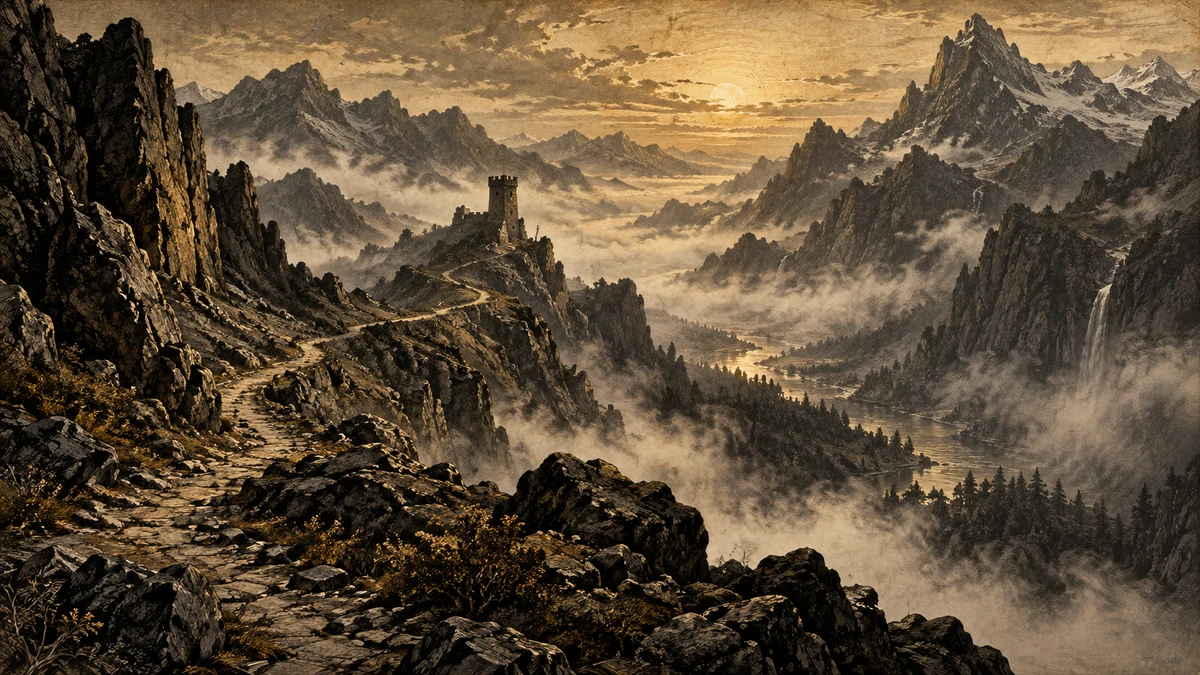
The three images in this guide are conceptual AI artwork about cartography and landmarks. They do not reproduce Drakhthar's official geography or establish new canonical locations. For actual region names and positions, use the linked interactive map.