 DRAKHTHAR
DRAKHTHAR
DRAKHTHAR
The Dominion of Eternal Ice
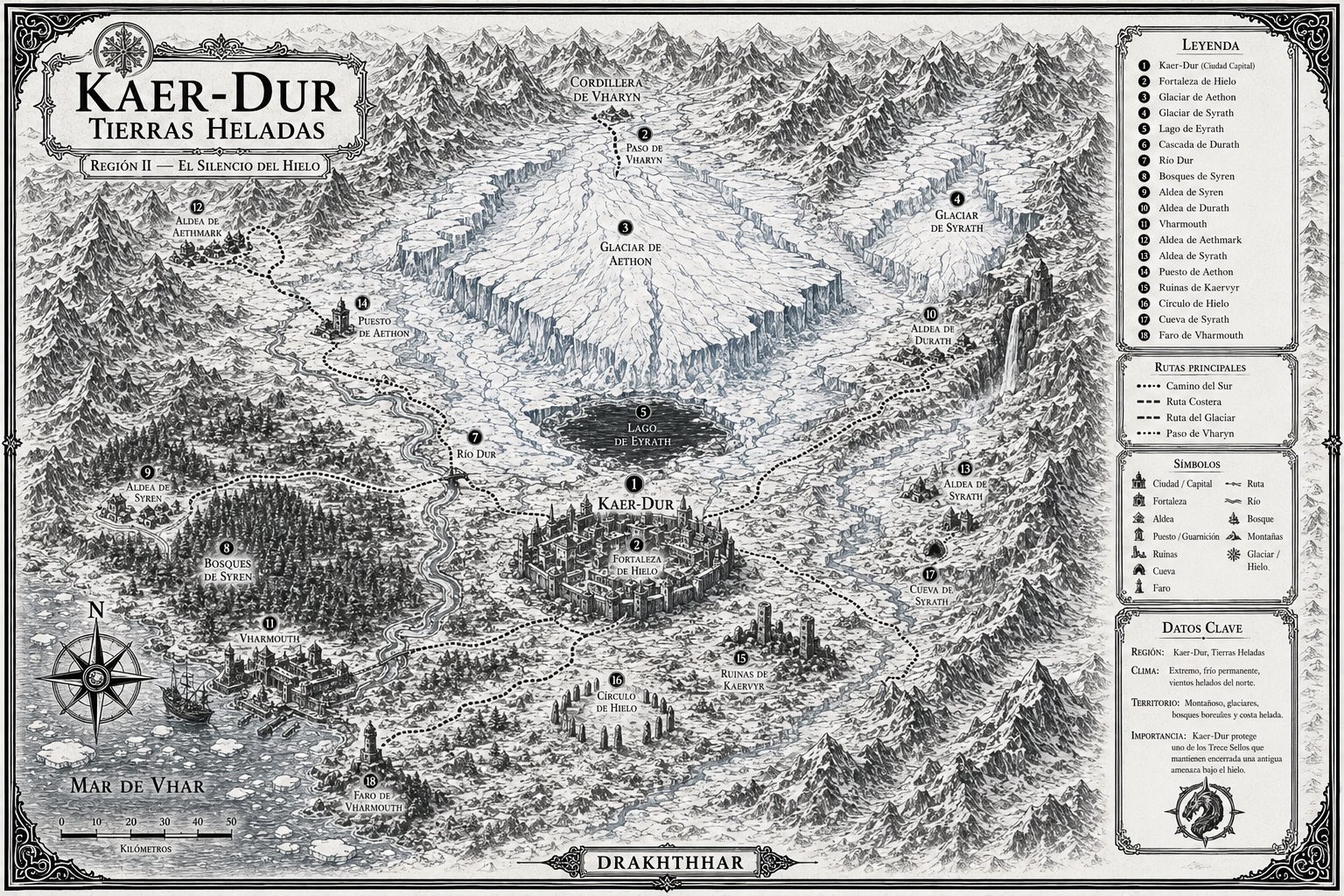
Click to enlarge · Official map of Region 02
Kaer-Dur was always cold. Before the first settlers arrived, before the first stone of the citadel was laid, the north was already a place where the wind never stopped and the snow fell in every season. Those who chose to stay did not do so because it was a kind place. They did so because it was theirs.
The city of Kaer-Dur grew around the central glacier — not upon it, but beside it, keeping a distance no one had ever formally decreed but that everyone observed. As if the city knew instinctively that the glacier was not merely ice. That there was something inside. That the something slept — but slept lightly.
For generations Kaer-Dur was known as the most stable region on the continent. While other regions suffered wars, eruptions or corruptions, the north remained unchanged. Cold. Silent. Frost's pulse was constant, regular — a heartbeat that had gone unaltered for centuries.
That pulse remains constant. But of late, something in it has changed — not into danger, but into something different. Like a thing that has shifted from its accustomed place and has not yet found its new one.
The city of Kaer-Dur is a citadel of dark stone and permanent ice, built at the heart of the region where four glaciers converge to form a natural valley sheltered from the wind. Its towers are reinforced with a blend of local stone and glacier ice that renders it virtually indestructible — and bitterly cold even in summer.
The streets are strewn with volcanic sand imported from other regions to give footing on the ice. The buildings have double walls with an air gap between them. The windows are small and few — light is not a priority when cold is the chief enemy.
Administrative and military heart of the region. Built upon the oldest rock in the valley, its foundations reach down to the glacier itself. From its highest towers, on clear days, you can see the northern horizon where the continent ends and the sea of ice begins.
The largest of the four glaciers surrounding the city. It creeps slowly southward — so slowly no single generation has ever seen an appreciable difference. The inhabitants measure it with marks cut into the rock. They say that when the glacier touches the city's first mark, something momentous will happen.
A subglacial lake of dark, perfectly still waters. In winter it freezes solid. In summer its surface mirrors the sky with an unsettling clarity. No one fishes it — not because it is forbidden, but because the fishermen who have tried say that something watches from below.
A structure on the region's southern coast, where the Sea of Vhar meets the lands of Kaer-Dur. Its flame has burned without interruption since before any historical record. No one remembers who lit it, nor how it is sustained. Sailors have steered by it for centuries.
A port city on the southern coast, warmer than the capital — though that isn't saying much. The main port of entry and departure for goods. The place where southern traders prefer to stay rather than venture farther north toward the main citadel.
An abandoned settlement at the far eastern edge. No one knows exactly what happened there. The historical records mention a hurried evacuation several centuries ago. The structures still stand — the cold has preserved them perfectly. But no one lives in them. And no one asks why.
Kaer-Dur is inhabited mostly by humans of the north — taller, sturdier and more silent than their southern counterparts. Generations of adaptation to extreme cold have shaped them in body and culture alike. They are not hostile to outsiders, but neither are they warm. Warmth, in Kaer-Dur, is a scarce resource not to be wasted on gestures.
The original settlers of the region and builders of the first citadel. They bear the name of the great glacier as a mark of lineage and pride. They control the city's administration and access to the Vharyn Pass, the main route through the Northern Range.
A people of fishermen and sailors settled in the coastal forests of the west. More open to the outside world than the Vharyn, they are the chief trading intermediaries between Kaer-Dur and the southern regions. They know sea routes that appear on no official map.
A clan of mountaineers dwelling on the slopes of the Vharyn Range. Masters of survival in the extreme, guides of the Northern Pass, and the only ones able to move swiftly across the glacier. They speak little, even by the standards of Kaer-Dur.
Kaer-Dur exports mainly furs, medicinal ice, polar stone and goods from the sea. Medicinal ice — distilled from the Aethon glacier — has healing properties found nowhere else, prized for burns and infected wounds. It is the region's most valuable product, and the one the Vharyn guard most jealously.
The official currency is the Durmark — a coin of glacier silver, lighter than gold and more resistant to extreme cold than any other known alloy.
The main route toward Vhar-Kaz and the central regions. Its northern stretch is passable only in summer. The caravans that use it are required to hire Durath guides — without them, the rate of losses in the Vharyn Pass is unacceptable.
A sea route controlled by the Syren. It links Vharmouth with the ports of the southern continent. Faster than the overland road, but perilous in winter, when the storms of the Sea of Vhar turn unpredictable.
An internal route between the region's settlements, crossing the packed ice of the Syrath glacier. Only the Durath know it in full. In winter it is the sole link between the north and south of the region.
The only natural passage through the Northern Range. Controlled exclusively by the Vharyn. The toll is steep. Access can be denied without explanation. No one knows what lies beyond the range, because no one who has tried to cross it without permission has ever come back to tell.
The creatures of Kaer-Dur are so perfectly adapted to the cold that most are invisible against the snow. Those who don't know how to look never see them until it is too late.
A predator with white fur and eyes of an almost transparent blue. Alone, they avoid humans. In packs they are lethal and calculating — they circle their prey for hours before striking, waiting for exhaustion. The Durath respect them as equals and never hunt them.
A black-skinned animal found both in the Sea of Vhar and in Lake Eyrath. The Syren hold it sacred, and its hunting is forbidden by ancestral custom. It is said that their gathering in great numbers heralds a storm. It is also said that some possess more intelligence than they should.
A serpentine creature that moves through the ice as if it were water. No one has seen it whole and lived to describe what they saw. It is known by the tunnels it leaves in the glacier, and by the missing who are never found. Clan Durath has specific protocols for whenever a new tunnel appears.
A bird of exceptional wingspan whose plumage changes color with the temperature. In winter it is pure white. In the few days of summer it develops grey markings. The Vharyn use them as messengers between settlements — they are the only birds able to fly in the conditions of the Vharyn Pass.
A completely transparent fish that dwells in the subglacial waters. Its flesh is one of the region's most prized foods — nourishing, with properties that help the body hold its warmth in extreme temperatures. Hard to catch, for it is nearly invisible in the water.
No one knows what it is, exactly. The fishermen who have tried to work Lake Eyrath describe something vast moving beneath the surface — far too vast to be any known creature. Clan Vharyn does not answer questions about Lake Eyrath.
A black bird that lives on the city's rooftops. It never leaves. No one feeds them. No one knows what they eat. The Vharyn believe they carry messages from the dead preserved in the glacier. Not as metaphor — as literal fact. There are records of ravens delivering belongings of the dead to living relatives without anyone having sent them.
White in winter, grey in summer. The Durath hunt them regularly. Their behavior predicts the weather more reliably than the instruments of the Watcher's Tower — when the hares dig their burrows deeper than usual, a great snowfall is coming. When they all flee in the same direction, something worse than snow is coming.
A bear of bluish fur that hibernates deep in the glacier caves. Generally harmless if given space. When a glacier bear leaves its cave out of season — in the dead of winter, when it should be hibernating — it means something has disturbed the glacier's interior. The Durath evacuate the area at once.
Beast of burden and companion to the Durath. Better suited to frozen ground than any horse. Some have served the same Durath families for generations — they know the glacier routes as well as their masters. When a reindeer refuses to advance along a familiar route, the Durath do not press it. The reindeer is always right.
Figures of light that move across the glacier on nights of the full moon. The Durath know of them but will not speak of them to outsiders. They are not dangerous — or at least, no one who has seen them has reported harm. But those who follow them do not always come back by the same path they went.
The Syren have a name for it in their dialect, but they refuse to translate it. Big — very big for the lake it inhabits. Transparent as the water itself, which makes it nearly impossible to see at shallow depths. The fishermen who have tried to catch it report that the line simply... vanishes. No tug. No cut. It just vanishes.
The people of Kaer-Dur are people of few words and many silences. Not out of hostility, but because in the north silence has value — it is the sign that there is no storm, that the wolves are far away, that the glacier is not advancing. Silence is safety.
The Moonless Night — the darkest day of the year, when the sky is fully overcast and there is neither moon nor stars. Rather than fear it, the people of Kaer-Dur celebrate it by lighting thousands of torches along the citadel walls. It is said this is so Frost can see the city from wherever he may be. No one knows whether it works, but the tradition has not failed in centuries.
The Thaw — the few days each year when the temperature rises enough for the glacier's edge to retreat slightly. It is celebrated as a rare and precious gift. Children may play outdoors without their layers of protection. Adults drink hot mead in the squares. It lasts as long as the warmth lasts.
The Crossing — the rite of passage for the young of Clan Durath. It consists of crossing the Syrath glacier alone, from north to south, without a guide. Those who return are counted as adults. Those who do not return are remembered in silence. No one searches for those who do not return — that is the rule.
The cooking of Kaer-Dur is practical before it is refined. Its purpose is to warm and to nourish, not to impress. Its most famous dish is Hide Stew — a thick stew of wolf meat, crystal fish and arctic roots, simmered for hours, which the Durath carry in sealed vessels on their crossings. The chief drink is Burning Ice — a liquor distilled from glacier water and arctic berries, served hot, which paradoxically helps the body hold its temperature in extreme conditions.
The people of Kaer-Dur believe the cold is not the enemy — it is the guardian. The cold conserves, preserves, protects. What the cold cannot destroy is eternal. That is why they bury their dead in the glacier — not to forget them, but to preserve them forever. The greatest of Clan Vharyn have lain within the Aethon glacier for generations. It is said that if the glacier ever melts entirely, all the dead of the north will wake.
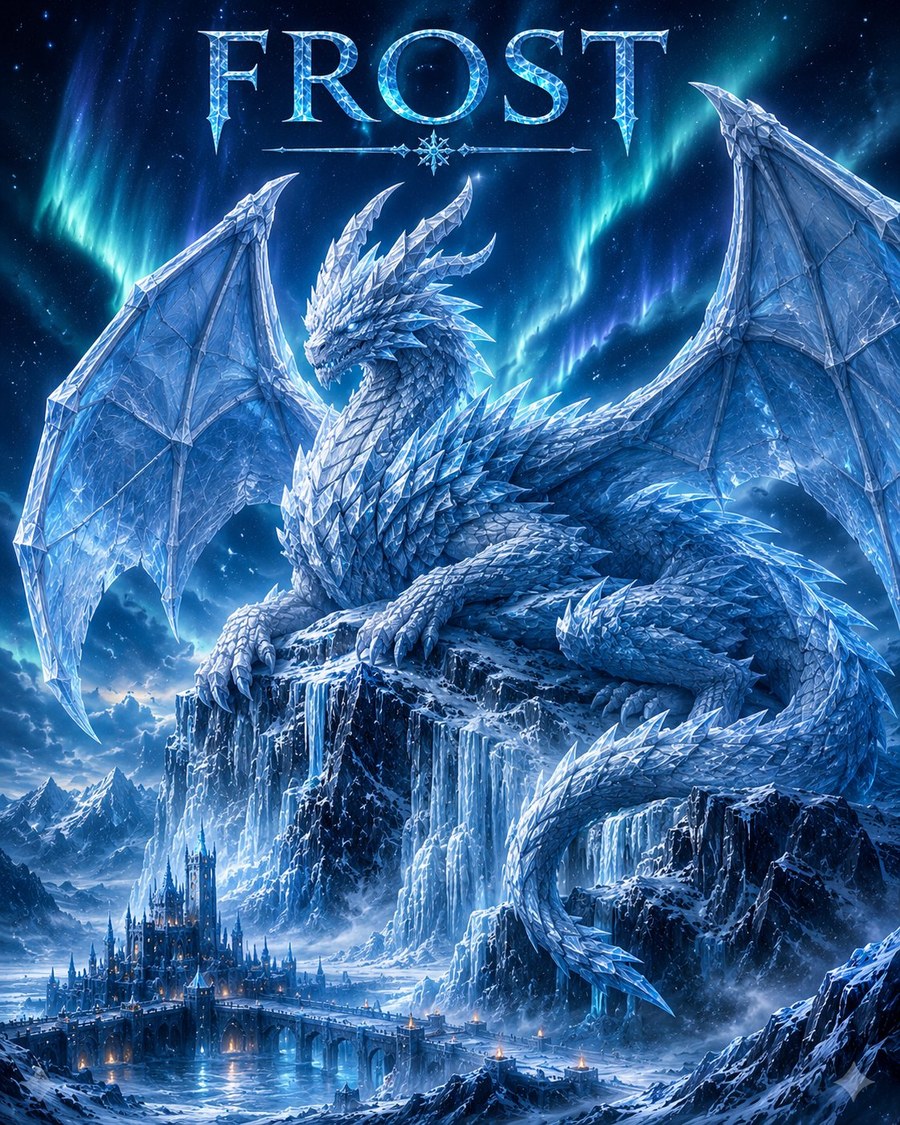
The youngest of the dragons still active — which still makes him very, very old. His pulse is constant, regular — the steadiest on the continent. He has a rider. And it shows in every movement.
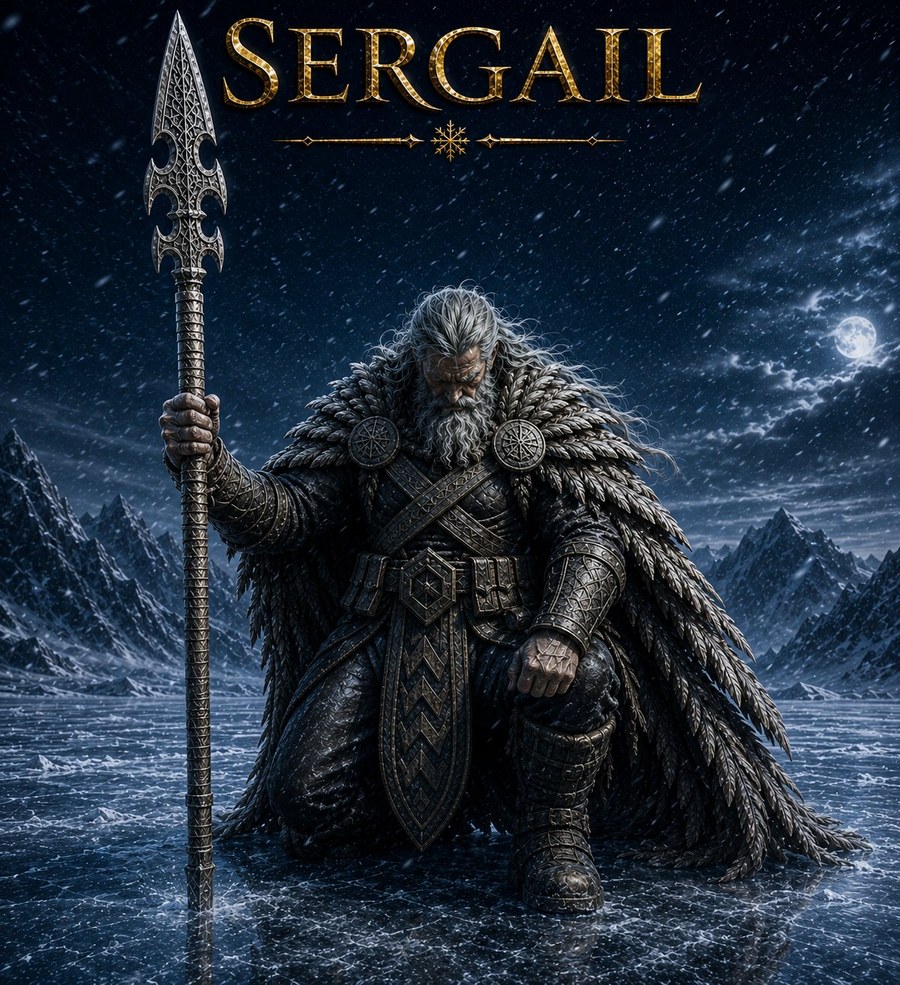
Frost's rider. A veteran of decades of journeying across the north. His bond with Frost is what every Named seeks and few ever find — whole, seamless, working as it was meant to work from the very beginning.
The FDM figures of Frost and Sergail are coming soon. Follow us to be the first to know.