 DRAKHTHAR
DRAKHTHAR
DRAKHTHAR
The Iron Strongholds
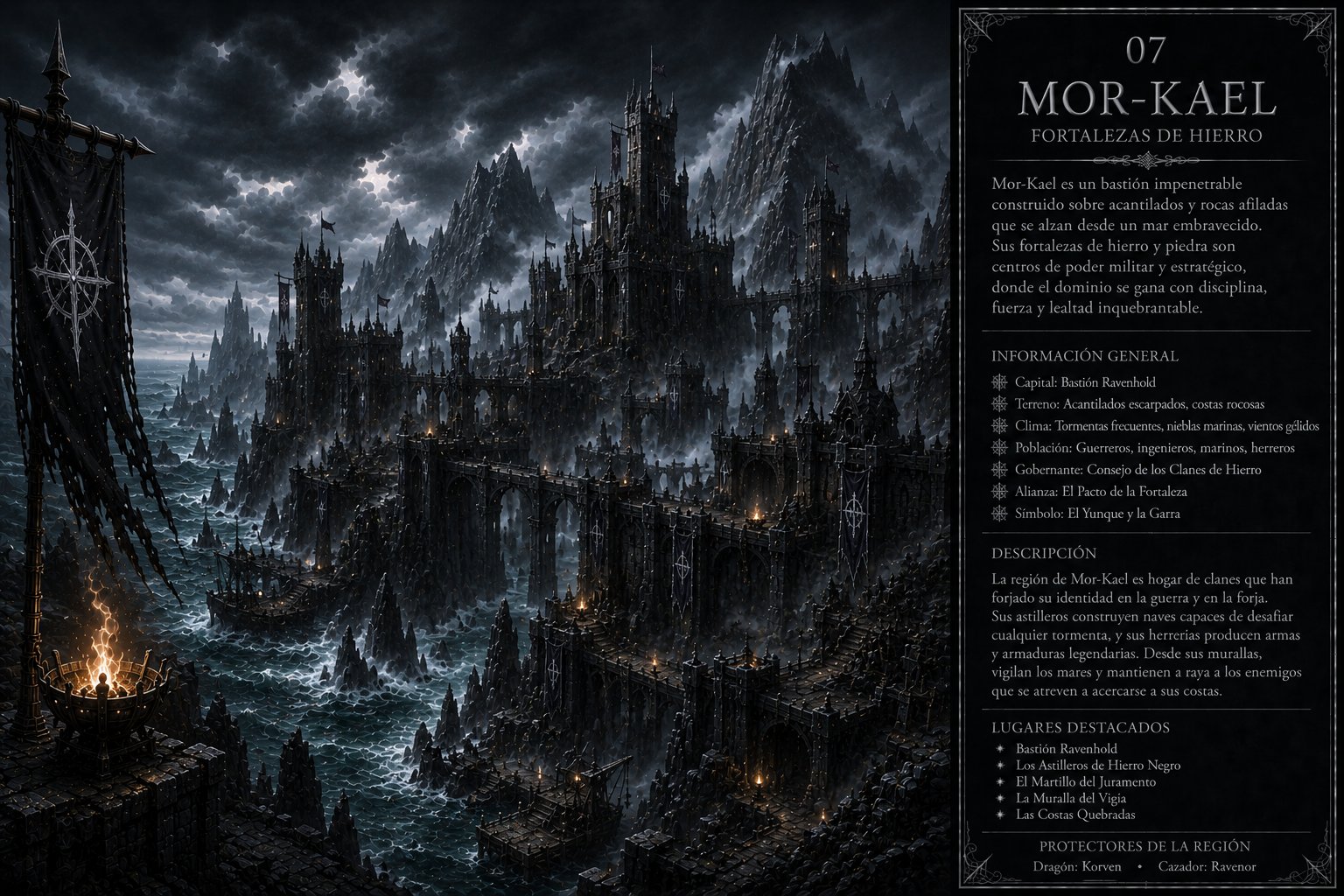
Detailed map coming soon · Region 07 — Mor-Kael
Mor-Kael is a gorge. Not just any gorge — the gorge. A rift in the earth so deep the sun reaches the bottom only three days a year, so narrow in places that two people cannot pass at once, and so long that crossing it end to end takes five days at a good pace. The walls of the gorge bear oaths carved into every available inch of stone. No one knows how many there are. No one has ever finished counting them.
The strongholds of Mor-Kael do not stand in the gorge — they stand above it. Built along the rims, joined by chain bridges over the abyss, controlling the only passable crossing between the east and west of the continent at that latitude. Whoever controls Mor-Kael controls the trade of half of Drakhthar. Its people know this. They have always known it. And they have built their entire culture around that responsibility.
Mor-Kael the dragon lives inside the gorge. Not on the walls, nor at the bottom — within the rock itself, as if the gorge were its body and the strongholds its teeth. No one has ever seen it whole. Only parts — a claw here, a wing there, an eye that opens in the gorge wall for a moment before vanishing. Ravenor has spent thirty years searching for a way to see it entire. He has not yet succeeded.
The settlements of Mor-Kael all stand on the rims of the gorge or hang above it. There are no cities within — the interior is the dragon. The strongholds are at once dwelling, workplace and weapon for controlling the trade crossing.
The principal stronghold, at the highest point of the gorge's northern rim. From its battlements the entire trade crossing can be seen — every caravan, every riverboat, every traveler passing below. Its hall of oaths holds the written records of every major trade agreement to pass through Mor-Kael in the last four centuries. It is the most complete archive on the continent.
Seven bridges linking the strongholds of the northern rim to those of the southern rim across the abyss of the gorge. Each bridge has a name, a history, and a cutting point the guards know by heart. If a bridge is cut, the section of the gorge it commands is isolated. Bridges have been cut twice in the history of Mor-Kael. Both times for reasons the records describe only as "extreme necessity."
The entrance to the gorge from the east. Held by the largest garrison in Mor-Kael. The entry toll is fixed — no negotiation, no exceptions. Those who try to avoid the Eastern Gate discover there is no other way across that does not pass through territory even more tightly controlled.
The entrance at the far end. Smaller than the Eastern Gate, but no less controlled. The guard here has a reputation for being stricter — those arriving from the west come from less familiar regions, and the guards of the Western Gate have learned to be careful with what they do not know.
A cluster of forges specializing in black iron — an ore found only in the walls of the gorge and nowhere else. Weapons and armor of black iron are the most prized on the continent for their exceptional resilience. The waiting list for a commission from the Rim Workshops runs to years.
No one lives at the bottom. Technically no one is forbidden to descend, but those who have gone down — and come back — do not recommend the experience. At the bottom, the oaths carved into the walls seem to move. The darkness has texture. And sometimes, in the total silence of the depths, something can be heard breathing very slowly.
The people of Mor-Kael are the guardians of the most important crossing on the continent. They have held that duty for generations and have become something that is neither quite warriors nor quite merchants — they are arbiters. They know the laws of trade better than anyone, because they are the ones who enforce them.
The ruling class of Mor-Kael. Their name comes from their most important duty — they are the official witnesses of oaths. A deal sealed before an Oathkeeper carries more legal weight in most regions than any written document. They have built their power upon that duty for centuries.
Professional soldiers who hold the strongholds and the bridges. They are not mercenaries — they are officials. Their loyalty is to Mor-Kael as an institution, not to any particular family or clan. The rotation system and the anonymity of the watches are deliberate: a nameless warden is harder to bribe.
Craftsmen of black iron, the ore exclusive to the gorge. So highly valued that they hold a near-diplomatic status — no region on the continent can afford to make an enemy of Mor-Kael if it wants access to black iron. The Black Smiths know this, and they wield it with elegance.
The economy of Mor-Kael rests on two pillars: the crossing toll and black iron. The toll is fixed, predictable and absolutely non-negotiable. Black iron is sold to order, with years of waiting and at prices that reflect its exclusivity. The official currency is the Oath — not a physical coin but a recorded debt. In Mor-Kael, money is information.
Everything that crosses Mor-Kael pays. People, goods, information, messages. The rate varies by type of cargo but never by the traveler's origin — a dwarf of Vhar-Kaz pays the same as a merchant from the south. The equality of the toll is the foundation of Mor-Kael's neutrality.
The toughest ore on the continent, found only in the walls of the gorge. Its properties are unique — lighter than ordinary iron, stronger than steel, and holding an edge as no other material can. The Black Smiths control its extraction and allow no one else down onto the walls.
Everything that crosses the gorge passes before the eyes of the Oathkeepers. Over time they have amassed more commercial intelligence than any other region on the continent. They sell it — selectively, discreetly, and at prices that reflect its true worth. They do not betray secrets outright. They merely share "market trends."
The Oathkeepers act as arbiters in trade disputes between regions. Their neutral position — they favor no region because they depend on all of them — makes them acceptable to every party. Mor-Kael's arbitration is the most expensive on the continent, and the most respected.
The fauna of Mor-Kael is divided between the creatures of the rim — living in the strongholds and the upper cliffs with access to the light — and the creatures of the depths, which never see the sun and have evolved accordingly.
Not a true dragon — a creature that dwells in the crevices of the walls and has grown scales of black iron through generations of exposure to the ore. Agile on vertical rock, all but impervious to ordinary weapons. The Black Smiths use its shed scales as an additional raw material. Obtaining those sheddings without the creature's consent is the kind of venture that ends at the bottom of the gorge.
A large spider that lives among the chains of the bridges and the suspension cables. Its silk is as strong as iron — the engineers of Mor-Kael use it to reinforce their structures. The trouble is that the spider also uses it to snare prey the size of a human. The bridge wardens learn to read patterns of fresh silk as a warning sign.
A bat with a three-meter wingspan that lives only at the bottom. Completely blind — it navigates by high-powered echolocation that can stun a human at close range. It is not aggressive unless something enters its space. The bottom of the gorge is its space.
A slender snake that lives in the cracks between the carved oaths. Its coloring mimics the graven stone perfectly — invisible unless it moves. Venomous, though its venom does not kill — it causes temporary amnesia. Those bitten forget the last few hours. The Oathkeepers consider this a grave problem, given how many oaths are sealed at those walls.
An eagle of great wingspan that nests along the highest rims of the gorge. The Wardens of the Pass use them as a messenger system between strongholds — faster than any runner and able to cross the gorge where no human could. Each stronghold has its own marked eagle. When one fails to return, something happened along the way.
A black-coated goat that walks the vertical walls of the gorge with an ease humans find unsettling. It feeds on the lichens that grow on the rock and on minerals it licks straight from the walls. Its meat tastes of iron. The people of Mor-Kael find it normal. Outsiders, less so.
A black raven that lives in the strongholds and that the Oathkeepers hold sacred. Tradition says the oath ravens can tell when an oath sworn before them is broken. The more superstitious Oathkeepers always keep a raven present at important agreements. The more rational ones do too, just in case.
A small lizard whose scales carry particles of black iron — they gleam with a dark metallic sheen. Omnivorous, adaptable, practically indestructible for its size. Soldiers adopt them as garrison pets. It is said that an iron lizard abandoning a stronghold is a sign that something bad is about to happen there.
Unlike the giant bat of the depths, this one is of ordinary size and completely harmless. It feeds on insects. The Black Smiths prize them because they gather where the walls hold the richest concentrations of black iron — natural detectors of rich veins. The bats charge no toll.
There is a river at the bottom of the gorge that almost no one knows exists. The fish that live in it are completely blind and translucent. The few who have reached the bottom and found it say the river makes a sound that is not water — something more like very slow words in an unknown tongue.
A shape that moves along the walls of the gorge on the three days a year when the sun reaches the bottom. Visible only in shadow — never in light. Its silhouette is vaguely draconic, but of proportions impossible for the space of the gorge. The Oathkeepers hold records of sightings going back four centuries. The first record and the most recent describe exactly the same thing.
At the bottom of the gorge, on the darkest days of winter, the oaths carved into the walls give off a faint glow. Not all of them — only some. The Oathkeepers have a theory: the ones that glow are oaths not yet fulfilled. Those who have tried to copy down which ones glow, to test the theory, have failed — the list changes every time they descend.
The culture of Mor-Kael revolves around one central idea: a word given is worth more than anything else. Not because its people are especially honorable — but because in Mor-Kael, breaking an oath carries concrete, documented consequences. The system is not built on morality. It is built on the record.
The Three Days of Sun — the three days a year when the sun reaches the bottom of the gorge. The only festival truly celebrated in Mor-Kael. The Wardens of the Pass descend to the bottom, the Oathkeepers read aloud the year's most important oaths, and the Black Smiths work directly on the walls by natural light. It is the only day the crossing toll is suspended. Everyone may cross for free. No one knows exactly why this tradition exists, but no one has ever questioned it.
The New Carving — when a major agreement is sealed, it is carved into the wall of the gorge. The ceremony is brief and unadorned: the Oathkeeper reads the agreement aloud, the parties confirm it, and the Black Smith carves it. The sound of the chisel on the rock is the only ritual. When it ends, the agreement exists forever in the wall.
The cooking of Mor-Kael is shaped by everything that passes through the gorge — the finest ingredients of every region eventually appear in its markets. Its signature dish is the Stew of the Pass — a pot that changes with whatever is available that day, reflecting which caravans have crossed recently. Iron Beer — brewed from filtered water of the river at the bottom, with a trace of the black ore — is bitter and potent. Outsiders find it difficult. The people of Mor-Kael find it medicinal.
The people of Mor-Kael believe the gorge is a living being — not the dragon, but the gorge itself. The oaths carved into its walls are neither decoration nor record — they are the gorge's memory, and the gorge remembers them. To break an oath carved into the wall is not to betray the other party to the agreement. It is to betray the gorge. And the gorge has spent four centuries proving it has ways of answering that.
The dragon that is the gorge itself — no one has ever seen it whole, only a claw in one wall, an eye that opens in the rock and closes again. It holds the region’s seal within the living stone, and every oath ever carved into the gorge is carved into its body. It does not guard Mor-Kael. It is Mor-Kael.
Guardian of the oaths carved into the gorge, he has spent thirty years searching for a way to see the dragon entire, and has not yet succeeded. He knows every stronghold, every chain bridge, every promise the rock has been made to keep — for in Mor-Kael an oath is sworn before the stone, and the stone does not forget.
13 regions, 13 dragons, 13 legends. Explore the Codex or return to the beginning.