 DRAKHTHAR
DRAKHTHAR
DRAKHTHAR
The Lands of Stone and Mines
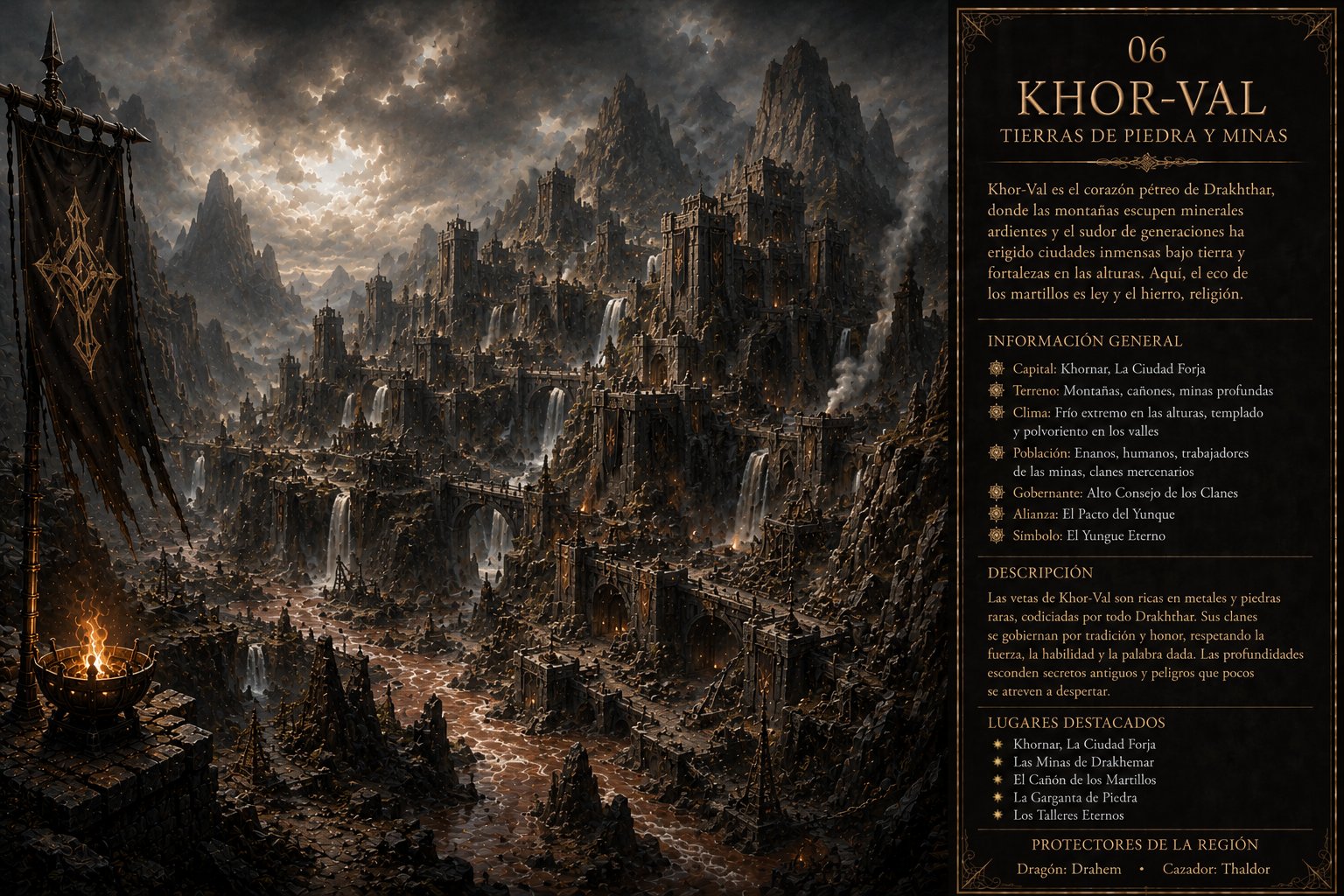
Detailed map coming soon · Region 06 — Khor-Val
Khor-Val is the oldest region in geological terms — the rock that forms it predates every other formation on the continent. Its quarries descend for miles beneath the surface, following veins of ore that do not end where the maps say they end. The miners of Khor-Val have been digging for generations and have yet to reach the bottom of anything.
Drahem, the dragon of Khor-Val, is so ancient that his hide has turned to rock. Not metaphorically — literally. His scales are stone, his claws are stone, his eyes are stone with light inside them. He moves with the slowness of something that has forgotten it was ever fast and finds no reason to remember. An encounter with Drahem does not feel like meeting a living thing — it feels like watching a geological formation suddenly decide to move.
Thaldor the Miner has spent decades following the dragon — or more precisely, following the tunnels Drahem leaves behind when he moves. The dragon digs. He is always digging. Downward, always downward. Thaldor does not know where he is going. But he has decided that finding out is the most important thing he can do with his life.
The settlements of Khor-Val are built directly on the rock or carved into it. There is no wood, no soil — everything is stone. The cities of Khor-Val are extensions of the quarry, raised along the rims of the extraction pits with the same practical logic that governs the mines: function first, beauty second, and only if there is time left over.
A city built on the rim of the Great Pit — the deepest quarry in the region. Its streets are terraces cut into the pit wall, linked by stairways and cargo ramps. From the upper level you can see the bottom of the pit on clear days — though a "clear day" in Khor means the rock dust has settled enough to see more than a hundred meters.
An extraction complex north of the capital. It produces most of the building stone exported to the rest of the continent. Its workers live in barracks carved into the quarry wall — practical, though outsiders find it claustrophobic. The workers prefer it to tents on the surface.
Not a settlement, but a place. The river that crosses Khor-Val carries veins of natural silver in its bed — visible from the surface when the water runs clear. Silver seekers have worked its banks for centuries. Those who find something significant rarely speak of exactly where they found it.
A settlement of artisans who specialize in ornamental stone-cutting. Unlike the miners, the Cutters work with precision — their pieces sell as decoration to the wealthy regions of the continent. They have a reputation for arrogance. They say they simply know what their work is worth.
The region's only access to the sea. Carved directly into the coastal cliff. Ships enter through a natural tunnel and dock in an inner cavern. Completely sheltered from storms — and completely indefensible if anyone decides to block the entrance. The Khor-Vali know it, and they have plans for that eventuality.
The deepest level of the Great Pit the miners have officially reached. Below it there are tunnels, but they are not tunnels made by men. They are tunnels made by Drahem. Access to Level Zero is restricted. Miners who have gone down without permission come back with different eyes. They do not explain what they saw.
The people of Khor-Val are physically compact and extremely hardy. Generations of working the rock have given them dense muscle, lungs adapted to dust, and a tolerance for constant noise that outsiders find unnerving. They do not shout when something is urgent — they simply speak faster.
Miners and diggers. The largest population. They work in continuous shifts — in Khor-Val the mines never stop. Their underground signalling system is the most sophisticated on the continent: knocks on the rock that carry messages for miles with astonishing precision.
Artisans of ornamental stone-cutting. They consider themselves above the miners — they create, while the miners merely extract. The miners consider them pretentious. Both groups are equally indispensable, and both know it, which does nothing to improve the relationship.
Independent prospectors who work the Silver River and the secondary veins. Loners by nature, distrustful by trade. They share very little among themselves — the location of a good vein is the most valuable thing a Seeker can own. It goes with them to the grave.
Khor-Val exports building stone, minerals, silver from the river, and ornamental pieces from the Cutters. It moves more tonnage than any other region on the continent — the ships leaving Rockharbor always sail loaded to the limit. The official currency is the Canto — a coin of volcanic stone imported from Vhar-Kaz, heavy and practically impossible to counterfeit.
The main export route. The stone ships of Khor-Val are the heaviest on the continent and demand specialist captains. The southern route connects to the coastal regions that are the biggest buyers of building material.
The overland route north, toward Vhar-Kaz and beyond. Built by the Khor-Vali themselves from their toughest stone — it is the most solid road on the continent. Ironically, it is also the most expensive to maintain, because the weight of the cargo wears it down relentlessly.
The silver of the Silver River is not traded officially — the Seekers are independent and sell to whomever they please. But established buyers have waited years in Rockharbor for the Seekers to arrive with their pouches. The Seeker sets the price. Always.
The Cutters' pieces sell for prices the miners find scandalous. A decorative panel by a master Cutter can be worth more than a year's output from a mid-sized mine. The Cutters find that entirely reasonable.
The wildlife of Khor-Val is fully adapted to a world of rock, dust, and darkness. Most creatures live underground or on the cliffs. Those that live on the surface are tough, practical, and utterly indifferent to the constant din of the quarries.
A scorpion up to half a meter long with a carapace that perfectly mimics the texture of the local rock. Practically invisible when still. Its venom is not lethal to a healthy adult, but it paralyzes the affected limb — fatal if it happens somewhere a fall means death. Miners wear reinforced boots specifically because of them.
A serpent that can move through cracks in the rock with astonishing speed. It carries no venom — it doesn't need to. Its jaws can punch through leather and wood. The miners of the deep levels fear it more than cave-ins, because cave-ins at least give warning.
A beast of considerable size that digs galleries parallel to the miners' own, weakening the walls between them. It is not aggressive toward humans, but its galleries have caused more collapses than any other factor in the history of Khor-Val. The Khor keep vibration detectors calibrated specifically to the Giant Mole's digging pattern.
Not exactly a creature. It is a concentration of mineral spores that gathers in the deepest levels and reacts to movement — when something passes through it, it stirs and clogs the lungs. Miners who have survived contact describe the sensation as breathing stone. Those who have not survived describe nothing at all.
A lizard whose scales reflect light like tiny mirrors. They feed on the insects that live in the cracks of the rock. Miners consider them lucky — where there are silver lizards, the rock is stable. When they vanish from a section of tunnel, the miners vanish from that section as fast as they can.
A raptor that nests along the rims of the open quarries. It feeds on the rats and lizards that live in the rock. The Khor respect them — a hawk abandoning its nest on a quarry rim means the walls are unstable. For generations they have been the most reliable alarm system for imminent collapse.
A rat larger than average, with teeth capable of gnawing soft rock. Miners tolerate them because they eat the insects that damage the wooden structures. Tamed ones are used as gas detectors — just as in Vhar-Kaz. Some veteran miners insist their rats have saved their lives more often than any piece of safety equipment.
A large, hard-shelled insect that feeds on soft minerals. Completely harmless. Miners use them to locate veins of soft ore — where there are colonies of miner beetles, there is ore worth extracting. Some Seekers carry beetles in cages as prospecting tools.
A fish whose scales hold tiny particles of silver — they gleam with a silvery light especially visible at night. Edible and prized, though its metallic taste takes getting used to. The Seekers fish them regularly, and where the fish shine brightest, the concentration of silver in the riverbed tends to be highest.
A bat with translucent membranes through which its bones can be seen — bones that are partly quartz. It navigates by high-frequency echolocation that can detect cracks in the rock. Miners follow them into new sections — if the bats will not enter, the rock is not safe.
Miners who have descended to Level Zero report crystal formations that expand and contract in rhythm — as if breathing. The rhythm is regular, constant, and matches exactly the pulse of the dragon Drahem, according to those who can feel it. No one has brought a sample to the surface. Every sample taken has crumbled to nothing more than ten meters from Level Zero.
Under certain acoustic conditions in the deepest tunnels, the rock produces sounds the miners describe as voices. Not in any recognizable language — but with the cadence and rhythm of speech. The most superstitious Khor believe it is the rock trying to communicate. The most pragmatic say it is the gas working on the brain. The oldest say nothing at all.
The culture of Khor-Val is practical to the bone. There are no elaborate festivals, no lengthy ceremonies, no traditions that do not serve a concrete purpose. The Khor-Vali have a reputation across the continent for being cold and disinclined to celebrate. They prefer the term "efficient".
The Day of the Bottom — the annual commemoration of the day the first miners reached the deepest level yet dug. Each year a new level is added to the record. The celebration consists of descending to the deepest level reached that year, marking the rock with the date, and climbing back up. There are no speeches. There is no feast. There is rock beer — brewed with mineral water and barley — waiting at the top.
The Silver Auction — a twice-yearly event in Rockharbor where the Seekers sell their finds. It is the most important social event in the region — not because it is festive, but because it is when the most money changes hands. The Seekers appear, sell, and disappear. The buyers have waited months. The whole process takes a day.
The Kindling — held when a new tunnel is opened and the first torches are lit within it. A brief ceremony in which the most veteran miner of the crew enters first, alone, and stands in silence for one minute. If he comes out and says nothing, the tunnel is safe. If he comes out and says anything at all, the crew does not go in.
The food of Khor-Val is hearty and heavy — miners need fuel for their work and have no time for elaborate meals. Quarry Stew — meat of whatever is available, tough vegetables, and plenty of mineral salt — simmers in great pots that never leave the fire. Rock Beer is the official drink, brewed with water from the Silver River, with a distinctive mineral tang that outsiders call an acquired taste. Stone Bread — dense, dark, made from wholemeal flour with added mineral — is so hard that miners have been known to use it as a tool when nothing else is at hand.
The Khor-Vali have no organized religion, but they hold very precise superstitions. The most important: the rock remembers. Everything that happens in a tunnel is written into the stone in some way they cannot read but the dragon Drahem can. That is why no one lies in the mines — not out of morality, but because the rock knows, and so does the dragon. Those who have lied in the mines have suffered accidents the Khor-Vali describe as "the rock remembering".
A dragon so ancient that his hide has turned to rock — scales of stone, claws of stone, eyes of stone with a light inside them. He moves with the slowness of something that has forgotten it was ever fast, and he is always digging: downward, always downward, for reasons no one has learned. To meet him is to watch a geological formation decide to move.
He has spent decades following the dragon — or rather the tunnels Drahem leaves behind when he moves. He does not know where the dragon is going, but he has decided that finding out is the most important thing he can do with his life. In Khor-Val patience is not a virtue but survival, and Thaldor has more of it than any man alive.
13 regions, 13 dragons, 13 legends. Explore the Codex or return to the beginning.