 DRAKHTHAR
DRAKHTHAR
DRAKHTHAR
The Ancestral Forests
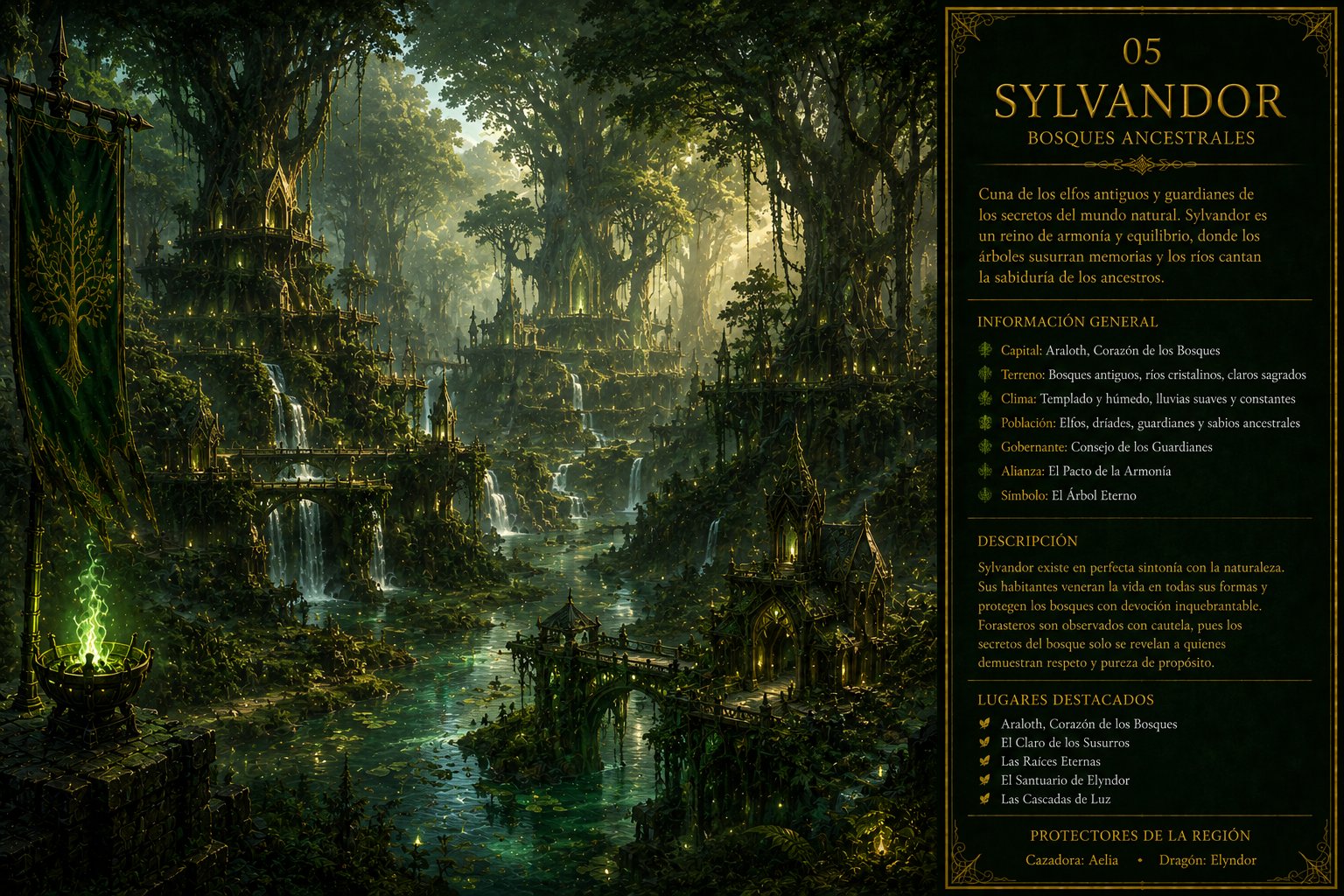
Detailed map coming soon · Region 05 — Sylvandor
Sylvandor is the oldest forest on the continent. Not merely in the sense that it has stood there a long time — though that is true as well — but in the sense that it predates almost everything else. The trees of Sylvandor grew before there were men to see them. Before there were dragons to guard them. Perhaps even before there was a continent to guard.
The dragon who bears the same name as the region did not choose that territory. He awoke within it. There is a difference. Sylvandor the dragon remembers no time before the forest, because for him no such time exists — the forest and he are one and the same, or at least they have been together so long that the distinction has ceased to matter.
Those who come to Sylvandor for the first time always describe the same thing: the feeling of being watched. Not with hostility — with curiosity. The forest weighs those who enter. Those who pass its judgment find paths that were not there before. Those who fail discover that the paths they used to enter are gone.
Aelion has spent decades in the forest learning to listen to Sylvandor. Not the dragon — the forest. The dragon is the forest, and the forest speaks, but in a tongue that takes time and silence to learn.
The settlements of Sylvandor are not built — they are negotiated. Every structure that exists in the forest exists because the forest has allowed it. Those raised without permission do not last — the trees surround them, invade them, absorb them. Within a matter of years they vanish as if they had never been.
A city built among the largest trees in the region, its structures woven into the trunks rather than cut from them. There is no felled timber in Sylvan — everything is stone, root, and living branches that have grown to meet the city's needs. From the outside it looks like part of the forest. Because it is.
Twelve clearings scattered through the forest where light falls unbroken. They are the only places where the sky can be seen from inside Sylvandor. The inhabitants use them to find their bearings, for ceremonies, and to speak with those who come from outside — the forest considers them neutral ground.
A river that crosses the region whose water is naturally bioluminescent — glowing faintly at night with a blue-green light. The inhabitants drink it with no ill effects. Outsiders who have drunk it report unusually vivid dreams for days afterward. Herbalists from other regions pay exorbitant prices for it.
Settlements built in the branches of the greatest trees, twenty to forty meters above the ground. Connected by vine bridges. The inhabitants descend to the forest floor regularly but sleep in the heights. They say the forest looks different from above — things make sense up there that make no sense below.
A place at the core of the forest where Sylvandor the dragon sleeps, rooted into the earth. It is not somewhere you go — it is somewhere you arrive, if the forest decides you are ready. Those who have seen it describe a tree of impossible proportions whose roots are the dragon and whose branches reach higher than anything else in the region.
The innermost and most ancient part of Sylvandor. No one lives there — not because it is formally forbidden, but because the forest simply does not let anyone in. The paths close. The trees draw nearer. Those who have tried to force their way in have not found the way back on their own.
The inhabitants of Sylvandor do not consider themselves the forest's owners — they consider themselves part of it. Generations of living among the trees have changed them physically: skin with greenish tones in the veins, eyes that see better in the forest gloom than in full daylight, and a bond with plants that herbalists from other regions describe as "too close to be mere knowledge".
The original inhabitants. Builders of Sylvan and keepers of the Sacred Clearings. They know the name of every great tree in the region — not a name they gave it, but the name the tree bears. Learning those names takes years. Pronouncing them correctly, decades.
A clan that lives exclusively in the hanging villages. Masters of moving through the branches as easily as across the ground. They hunt from the heights, communicate with whistles that mimic the forest's birds, and descend to the ground only when absolutely necessary. Generations have passed since they last set foot on solid earth with any regularity.
A small order devoted to interpreting the forest's messages. They are neither shamans nor priests — they are closer to translators. The forest speaks through shifts in the wind, the behavior of animals, the growth of plants. The Listeners have kept a record of those signs for centuries.
Sylvandor exports mainly resins, medicinal plants, water from the River of Light, and seeds of species that grow nowhere else. It does not export timber — ever. Felling a tree in Sylvandor is not formally forbidden, but no inhabitant would do it, and the outsiders who have tried have had experiences they do not repeat.
The official currency is the Silver Leaf — a sheet of fine metal pressed with the veins of real leaves. Light, and hard to counterfeit, because the vein pattern of each piece is unique.
The only official trade route in and out of Sylvandor. Narrow, marked with signs that only Sylvani guides can read correctly. The merchants who travel it always go accompanied — not for safety, but because without a guide the path simply disappears.
Water from the River of Light is the region's most valuable export. It is sold in small quantities — the Sylvani control how much leaves the forest. Too much, they say, and the river loses its glow. The usual buyers are herbalists, alchemists, and people of means chasing the vivid dreams it brings.
Some plant species of Sylvandor do not grow outside the forest — they die when taken too far. But others can be transplanted, if it is done correctly. The Sylvani know which ones, and charge steep prices to teach the process. They do not always teach all of it.
Produced by bees that pollinate only the flowers of Sylvandor. Its flavor is intense and complex, changing with the season. It has modest healing properties for surface wounds. It is exported in small quantities and sells at outrageous prices in the northern regions.
The creatures of Sylvandor have been in the forest as long as the forest itself. Many do not exist beyond its borders — not because they could not survive outside, but because they do not want to. The forest is their world. What lies beyond does not interest them.
A spider of considerable size that weaves invisible webs — not transparent, but truly invisible, even in full daylight. Its venom does not kill — it numbs, and brings on hallucinations in which the victim believes the forest is speaking to them. The Listeners use minute, carefully controlled doses of the venom in certain ceremonies. The uninitiated who take a full bite need days to come back to themselves.
A beast of exceptional size with tusks that can split a middling trunk. Fiercely territorial in breeding season. The people of the hanging villages know them well, because root boars are the main reason those villages were built in the heights. On the ground, the boars rule.
Not exactly a creature, but it behaves like one. A carnivorous plant large enough to trap medium-sized animals. Its flowers smell exactly like the most sought-after medicinal blooms in the region. Novice herbalists learn this lesson fast. Those who do not learn it in time are not always around to tell it.
A large nocturnal bird that dwells in the Old Forest. Its feathers absorb light — they do not reflect it, they literally absorb it, which makes the bird all but invisible in the dark. Silent in flight. The people of Sylvandor do not enter the Old Forest at night for several reasons. The Dark Owl is one of the most compelling.
A deer with silver-grey hide and antlers that glow faintly at night. Completely tame with the people of Sylvandor — they approach the villages without fear. With outsiders, they keep a distance precisely proportional to the visitor's intent. The Listeners use them as the first sign of whether a stranger is welcome.
A butterfly with translucent wings that refract light in unique patterns. Every individual bears a different pattern — the most observant Sylvani can recognize specific individuals. It is said their flight patterns carry news of the state of the surrounding forest. The Listeners study them.
A squirrel of ordinary size with one singular trait: it produces complex melodies, not simple chirps. The High Hunters have studied them for generations and hold that the squirrels speak to one another through those melodies. The exact meaning of each melody remains a matter of debate.
A bright green larva that gives off its own light. They move in patterns the Listeners read as messages from the forest. The children of Sylvandor gather them to light their rooms. The adults become crystal butterflies.
A medium-sized bird with no song of its own — it repeats the sounds around it with perfect precision. Outsiders are unsettled when they hear what seems to be human conversation and discover it was an echo bird. The Sylvani use them as a natural messaging system — an echo bird repeating a particular phrase means someone spoke it nearby.
The maker of the forest honey. Larger than ordinary bees, with green stripes instead of yellow. It does not sting the people of Sylvandor — generations of contact have bred a mutual tolerance. Outsiders do get stung, though the sting is milder than a common bee's.
Figures that look human but move among the trees of the Old Forest with a fluidity no human possesses. They are not hostile — they are simply there. The oldest Sylvani say they are the forest's first inhabitants, older even than the Sylvani themselves. The Listeners say they are the forest, moving. No one has managed to get close enough to see them clearly.
Unlike the walking trees of Vor-Khal, which drift slowly, Sylvandor holds one tree that travels at a visible pace — fast enough that if you see it in one place in the morning, it will be gone by evening. The Sylvani know it exists. They do not know where it goes or where it comes from. Nor do they know whether it is one tree, or many taking turns.
The culture of Sylvandor cannot be separated from the forest. There is no facet of daily life the forest does not shape — from how homes are raised to how the dead are mourned. The forest is not the backdrop of Sylvandor's culture. It is its foundation.
The Great Silence — one day each year when every inhabitant of Sylvandor keeps absolute silence from dawn to dusk. No work, no speech, no music. Only listening. The Listeners say that on that day the forest speaks more clearly than ever. The rest do not always understand what the trees are saying, but they feel there is something being said.
The Night of Roots — a solstice observance in which the people descend from the hanging villages and sleep directly on the forest floor. No tents, no shelter — flesh against root. Those who sleep well that night have dreams the Listeners interpret the following day. Those who sleep badly all have exactly the same dream: they are lost in the forest, and something is calling them.
The Naming — the ceremony in which a young Sylvani learns the name of their first tree. Not a name given to it — the tree's own name. Learning that name can take years. When they pronounce it correctly for the first time, the tree answers. Those who have witnessed it do not agree on how to describe that moment.
The food of Sylvandor is surprisingly varied for a forest region. River Mushrooms — which grow along the banks of the River of Light — are the base of most dishes. Forest Honey goes into everything, from meals to medicine. Silver deer meat is never eaten — forbidden by custom, not by law. Root Tea — an infusion drawn from the roots of particular trees — is the everyday drink, its blend shifting with the season and with what the forest has to give.
The dead of Sylvandor are planted. Literally — the body is laid in a trench beside a tree seed. In time the tree grows through the body. Trees grown this way are easily recognized by the Sylvani and are never cut. When someone wishes to speak with the dead, they go to the tree that grew from them. If you listen well, they say, the tree answers.
The dragon and the forest are one and the same — he awoke within it and remembers no time before it, because for him no such time exists. He does not walk Sylvandor; he is Sylvandor, and the forest weighs everyone who enters. Those it judges worthy find paths that were not there before; those it does not lose the way they came.
He has spent decades learning to listen to the forest — not the dragon, but the forest, which is the dragon, and which speaks in a tongue that takes time and silence to learn. He knows that the trees of Sylvandor have their own names, and that some have waited centuries for someone to pronounce them correctly.
13 regions, 13 dragons, 13 legends. Explore the Codex or return to the beginning.