
What makes a secret beneath a mountain compelling in epic fantasy? The locked chamber matters, but so does the society built around its locked door. In DRAKHTHAR’s Vhar-Kaz, the question reaches from the deepest level of an underground city to its guards, archives, trade and everyday rules.
Short answer: look at who can enter, who can read the records and who must live with the consequences of being kept outside. The official Vhar-Kaz atlas gives readers more to investigate than the contents of a sealed passage.
What is known about the sealed level?
The atlas describes a city excavated downward through a volcanic mountain. Its early diggers followed warmth and a presence they sensed beneath the rock. On the seventh level, they found something the surviving public account does not describe precisely. They stopped digging, sealed the access and posted guards.
Those statements establish a boundary around the mystery. They do not identify what the diggers found. A useful way to read the entry is to keep the known events separate from any explanation you might imagine. The silence of the guards is part of the evidence available to the reader; it is not an answer.
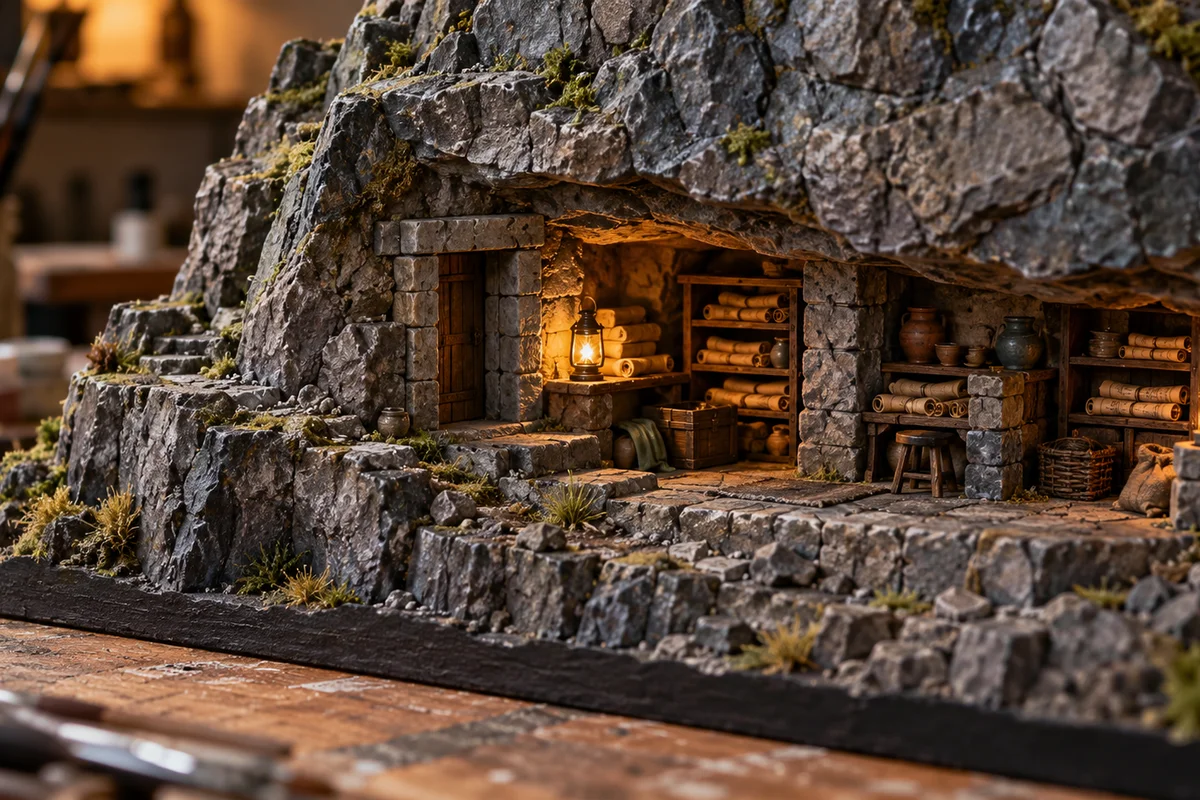
The city itself helps that silence carry weight. Khaz-Gor has streets, workshops, a market, a council chamber and ancestral halls above the restricted Deep Chambers. People can conduct ordinary business while living over a place they cannot freely inspect. The hidden level is therefore connected to an inhabited setting, rather than waiting alone at the end of a tunnel.
Who controls the way down?
Access is a practical question in Vhar-Kaz. The atlas says Clan Threshold guards the Deep Chambers. No one descends without permission or alone, and public historical records mentioning the seventh level have been removed. Other parts of the city have their own limits: outsiders are admitted at the Gate of the Titan, while the Great Forge is reserved for masters of Clan Forge.
| Place or source | What the atlas establishes | Question for the reader | |---|---|---| | Gate of the Titan | Outsiders may enter the trading district | How far can a visitor actually investigate? | | Great Forge | Entry belongs to Clan Forge masters | Who can inspect the city’s most valued work? | | Public archives | References to the seventh level have been removed | What can be checked independently? | | Deep Chambers | Clan Threshold controls access | Who decides when a witness may speak? |
The final column is a set of reading questions, not additional DRAKHTHAR lore. It shows why a secret can become larger than its hiding place: each restriction changes how knowledge moves through the city.

Why does the mountain feel inhabited?
An underground mystery needs ordinary life around it. The regional account places artisans, merchants and council representatives on different levels of Khaz-Gor. It describes a market supplied by the work below it, contracts carved in stone and light from forges and cultivated fungi. These details give a reader ways to picture people working, negotiating and travelling through the mountain before anyone approaches the forbidden descent.
They also make a useful test for any epic fantasy setting. If a passage closes, whose work is interrupted? If a record disappears, who would have used it? If a guard refuses to explain an order, who has the standing to challenge it? Such questions connect atmosphere to people with different responsibilities and different access to information.
Where should you start exploring?
Begin with the history and seven levels of Vhar-Kaz. Write down only what the atlas confirms about the sealed passage. Then read the sections on clans and trade and ask which people could seek further evidence.
For a wider view, the DRAKHTHAR Codex places Vhar-Kaz among the setting’s other regions. Return afterward to the mountain with one question: which part of its mystery depends on what lies below, and which part depends on the people who control the way down?