 DRAKHTHAR
DRAKHTHAR
DRAKHTHAR
The Corrupted Marshes
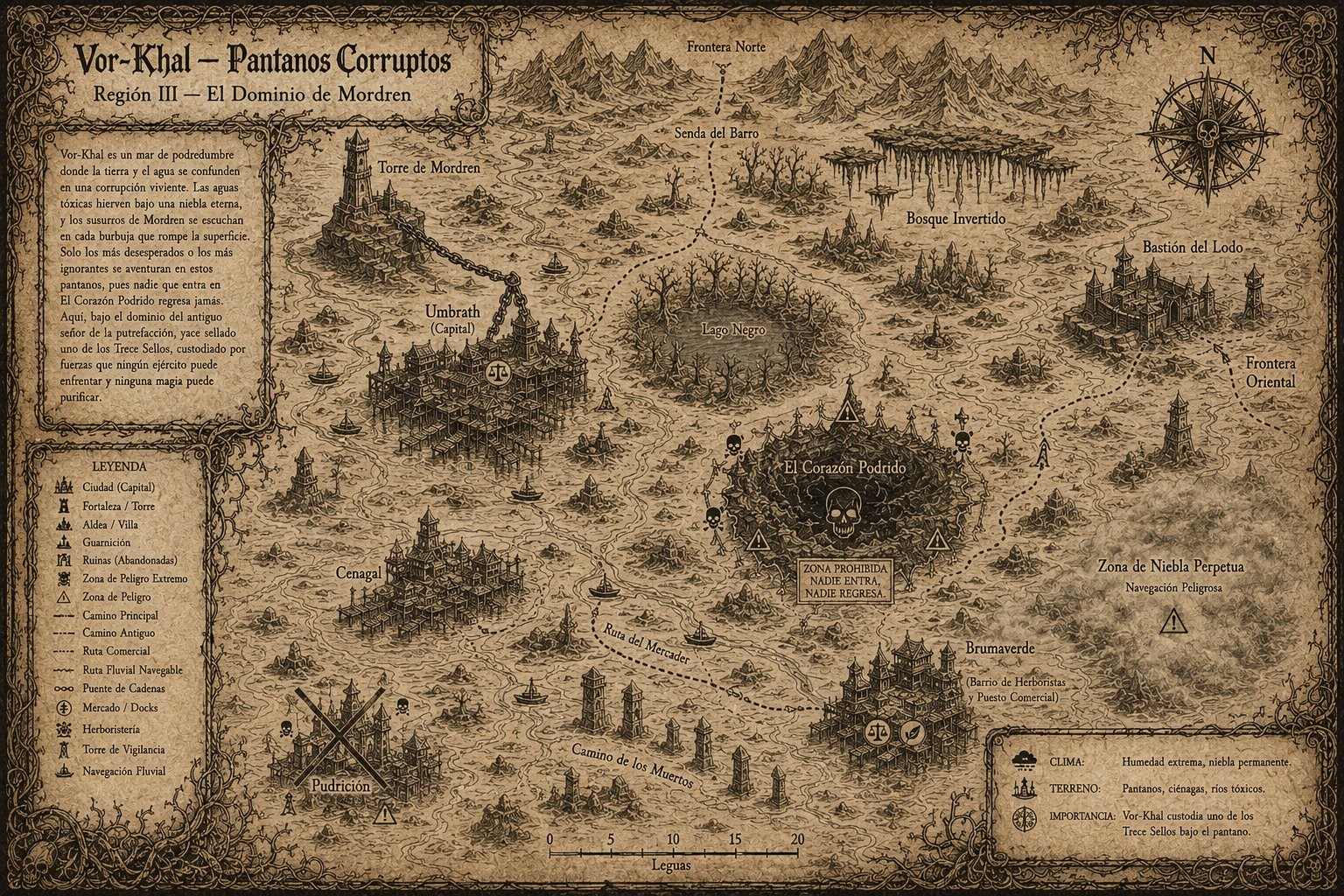
Click to enlarge · Official map of Region 03
Vor-Khal was not always a marsh. The continent's oldest texts describe it as a region of dense forests and rivers of clean water — one of the most fertile in Drakhthar. What happened to turn it into what it is now is not clearly recorded in any archive. The records simply stop mentioning the forests and begin mentioning the mist.
The most widely accepted theory is that the corruption comes from the seal. Vorlag has spent so long absorbing the pressure of what lies sealed beneath the marsh that no one knows for certain anymore whether the dragon holds the seal or the seal holds the dragon. What is clear is that the energy seeping upward has been changing the region slowly, year after year, for centuries — corrupting the water, twisting the trees, altering the creatures that live in it.
The inhabitants who remain in Vor-Khal do not live in the region because it is a kind place. They live in it because they have done so for generations and because, paradoxically, they have learned to survive in an environment that kills any outsider within days. They know the paths that appear on no map. They know which waters can be crossed and which cannot. And above all, they know how to keep far enough away from the Rotten Heart.
Umbrath is the capital of Vor-Khal — a city built on stilts of blacktree wood, the only timber that withstands the marsh's corruption without rotting in weeks. Its streets are raised walkways above the dark water. Its houses are low, sealed structures, designed to keep the warmth in and the mist out.
The city smells of sulfur and decaying vegetation. The mist never fully lifts — on the worst days it cuts visibility to a few meters. The inhabitants find their way by the sound of the bells that hang at the intersections of the walkways.
A city on stilts, linked by walkways of black wood. A floating market at its center, a dock district for marsh boats, and Mordren's watchtower at the northern end. The only city on the continent where the maps are updated every season, because the paths shift with the water.
A fishing village on the main river. It specializes in catching marsh eel — one of the region's few abundant foods. Its people know the river's currents better than anyone and can predict when the water will rise or fall.
A settlement of herbalists at the southern edge. The only ones who dare venture regularly into the marsh to gather medicinal plants. They hold an encyclopedic knowledge of which plants of Vor-Khal heal and which kill, and they trade in that knowledge as carefully as in the goods they gather.
A stone structure on a rocky island, connected to Umbrath by a chain of bridges. Watchpost and base of operations of the tracker Mordren. From its summit, on clear days — which are few — one can see as far as the edge of the Rotten Heart.
A military garrison on the eastern frontier. Its official purpose is to protect the region from outside incursions. Its real purpose is to keep what lies within from getting out. Soldiers posted here serve three-month contracts — no one stays longer of their own free will.
A former settlement in the southwest, marked with an X on every map. Evacuated decades ago for reasons the official archives describe as "unsustainable environmental conditions." The people of Umbrath do not speak of Pudrición. When asked, they change the subject with a speed that is telling.
The races that inhabit Vor-Khal have spent generations adapting to the corruption. They are not immune to it — no one is — but they have developed resistances that outsiders lack. Their skin tends to be darker, their eyes more attuned to the marsh's dim light, and their immune systems more robust against the toxins of the water and the air.
The original inhabitants of Umbrath. Merchants, builders and administrators of the city. They control the floating market and access to the docks. They are the most cosmopolitan people of Vor-Khal — they deal with outsiders regularly and have learned to profit from it.
Fishers and masters of the rivers. They live in near-perfect symbiosis with the marsh — they know when the water is safe, when it is not, and what lies at the bottom of every important channel. They do not share that knowledge easily.
A small but indispensable group. Their knowledge of the plants of Vor-Khal is irreplaceable — they produce medicines that cannot be obtained in any other region of the continent. They live longer than the rest of the inhabitants of Vor-Khal. No one has studied why.
Vor-Khal exports chiefly medicinal plants, cured marsh eel, blacktree resin, and natural dyes in colors that cannot be obtained in any other region. Its goods are prized precisely because they are hard to come by — the approach to Vor-Khal deters most merchants.
The official currency is the Khal — a bronze coin of a special alloy that endures extreme humidity without corroding. The people of Vor-Khal distrust paper as a form of payment — in the marsh, paper does not last.
The main route to the northern frontier. The only stable road in the region — stable in relative terms, since it requires constant maintenance to keep from sinking into the marsh. Heavy carts cannot use it. Everything is carried by boat or on the backs of pack beasts adapted to the terrain.
An old imperial road, now half submerged. Passable on foot only at certain times of year, when the water level drops. The Cenagali know it inch by inch and occasionally serve as guides for merchants who need to reach Umbrath quickly from the south.
A network of navigable channels between Cenagal and Brumaverde. Accessible only by flat-bottomed marsh boat. The Cenagali control access and charge a toll. It is the region's busiest trade route for goods of middling weight.
The link between Umbrath and Mordren's Tower. Not a trade route — it is the only connection between the capital and the tracker's watchpost. The chains that hold it must be replaced every two years, as the marsh's corruption slowly weakens them.
The creatures of Vor-Khal have been exposed to the seal's corruption for generations. Most have mutated in ways their ancestors would not recognize. Some are dangerous. Others are dangerous in ways you never see coming.
A reptile of up to four meters that uses the mist as active camouflage — its skin produces a local haze that renders it practically invisible. It has no venom. It needs none. It hunts by constriction, and it can stay underwater for hours waiting for its prey. The people of Umbrath never walk alone when the mist is thick.
Tiny grey-winged insects that appear in dense clouds at dawn and dusk. Their bite is not lethal but causes marsh fever — an unpleasant illness lasting days that steadily weakens anyone without built-up resistance. The people of Vor-Khal are practically immune. Outsiders are not.
A mutated reptile with black, gleaming skin. Smarter than an ordinary caiman — it learns from failed attacks and never repeats the same mistake. Fiercely territorial. The Cenagali know the territory of every caiman in the main channels and steer around them. Outsiders who do not know this learn fast, or never learn at all.
One of the few abundant food resources in Vor-Khal. Dark, strong-tasting flesh that requires special preparation to remove the toxins it absorbs from the water. Properly cured, it is nutritious and keeps well. It is Cenagal's chief export.
In the Inverted Forest there are trees that move. Not fast — slow enough that anyone not paying attention misses it. Constant enough that the trees stand in different positions each time someone returns to the same place. No one has documented how they move. Those who have tried to study it up close have not come back with their notes.
An amphibian with translucent skin that gives off a faint green light in the dark. The people of Umbrath use them as natural lamps on the walkways — a glowfrog in a glass vessel gives enough light to find one's way in the mist. They breed easily in captivity and need no special care.
A wading bird that stalks the banks, startled by practically nothing. The Cenagali use it as an indicator — if a heron suddenly takes flight, something in the water has moved unexpectedly. If every heron on a channel takes flight at once, the Cenagali abandon their boats and run.
Slow, ancient, its shell blanketed in green moss. Some bear markings on the shell that the herbalists recognize as ancient writing — not of the continent, but of something older. No one knows who put them there, or when. The herbalists of Brumaverde pay well for turtles with complete markings.
A graceful, long-legged animal that lives along the less corrupted edges of Vor-Khal. Its presence signals relatively clean water and firm ground. Its absence from places where it is normally found means something in that area has grown worse. Explorers follow them to find safe routes.
A completely harmless insect that buzzes throughout the region. Except near the Rotten Heart, where its color gradually turns black and its buzzing drops in pitch until it becomes almost inaudible. The people of Umbrath never ignore a black fly — it is the region's oldest warning system.
Unlike ordinary fireflies, these glow a deep red. They appear only near zones of high corruption. Outsiders find them beautiful. The people of Vor-Khal find them terrifying — the more red fireflies, the more corruption. A cloud of red fireflies means something has changed in the Rotten Heart.
The most constant sound in Vor-Khal — the song of the toads, day and night. The inhabitants no longer notice it. Outsiders take days to get used to it. What everyone notices is when the song stops. In Vor-Khal, the silence of the toads is the most reliable alarm there is. When they all fall quiet at once, something big is coming.
On the Black Lake, on days of dense mist, the water reflects things that are not on the shore. Not the sky — the shore. But the shore it reflects is not the shore of today. It is the shore as it was long ago, with trees that no longer exist and structures no one recognizes. The herbalists believe the lake has a memory of its own. The Cenagali simply do not look at the lake when the mist is out.
The Cenagali keep oral records of something at the bottom of the main channel that is neither sediment nor sunken log. It moves. Slowly, but it moves. No one has gone down to check. The fisherman Skar found something on the bottom months ago. He has not said what. But he no longer fishes that stretch of the channel.
The Rotten Heart is the center of the region of Vor-Khal — and the reason Vorlag is here. It is a zone several kilometers across where the corruption is so dense that the water runs black, the trees grow upside down with their roots in the air, and the ground shifts as if it were breathing.
No one who has entered has returned to describe exactly what lies at the center. Those who have reached the outer edge and looked inward report that the zone has a geometry that should not be possible — distances that do not add up, perspectives that shift, the sense that space inside the Rotten Heart works differently from space outside.
What is known: something is sealed beneath. And Vorlag has kept it sealed with its own body for centuries. The dragon never strays from the center. And with every passing year, the difference between the dragon and what lies beneath grows a little harder to tell.
The culture of Vor-Khal revolves around one central concept: adaptation. Not resistance — no one resists Vor-Khal. Adaptation. Learning to live with the marsh, with the mist, with the corruption that seeps into everything, with the constant presence of something dark at the center of the region that everyone feels though few will name.
The Night of the Low Mist — the night of the year when the mist sinks to the level of the water and Umbrath is wholly enveloped. Instead of shutting themselves in, the inhabitants go out onto the walkways with glowfrogs in glass vessels and walk in silence. No one speaks. No one sings. They only walk, green light in hand, remembering that the city is still there even when it cannot be seen.
The Day of the Tree — commemorating the day the founders of Umbrath found the first blacktree and understood they could build upon the marsh. A new tree is planted at the edge of the city. If the tree survives a year, it is a good omen. If it does not, no one mentions it.
The Offering to the Channel — each season, the Cenagali cast food, tools and personal belongings into the main channel. Not as payment to any god — but as an acknowledgment that the channel gives and the channel takes, and that it is better to stay on good terms with it.
The cooking of Vor-Khal is challenging for outsiders — not because it is bad, but because it takes knowledge to prepare it safely. Cured Eel is the main dish. Root Broth — brewed with medicinal plants from Brumaverde — is the drink the inhabitants take every morning as a prophylactic against the ambient toxins. Fungus Bread is made from fungi that grow on the stilts of Umbrath and has an intense, earthy taste that outsiders rarely appreciate on their first visit.
The people of Vor-Khal do not speak of Vorlag as a guardian. They call it The One That Absorbs. Not with fear, nor with reverence — with a kind of pragmatic recognition. They know that as long as The One That Absorbs remains, what lies beneath remains too. And as long as what lies beneath remains, at least they know where it is. The alternative — that it should cease to be there — is not something any inhabitant of Vor-Khal cares to contemplate.
He has absorbed the pressure of what lies sealed beneath the marsh for so long that no one knows anymore whether the dragon holds the seal or the seal holds the dragon. The corruption seeping upward from him has turned a fertile land of forests and clean rivers into a sea of rot, year by year, for centuries. What he is now, and what he still wants, no one can say.
From his tower on its rocky island he watches the one thing everyone else flees: the Rotten Heart, the core of the corruption. He knows the paths that appear on no map, which waters can be crossed and which cannot. More than anyone, he must learn the answer no one wants to ask — whether Vorlag can still be reached, or is already lost to the thing it holds.
The Drakhthar universe holds 13 regions, 13 dragons and 13 legends. Explore the full Codex or return to the beginning.