 DRAKHTHAR
DRAKHTHAR
DRAKHTHAR
The Eternal Storms
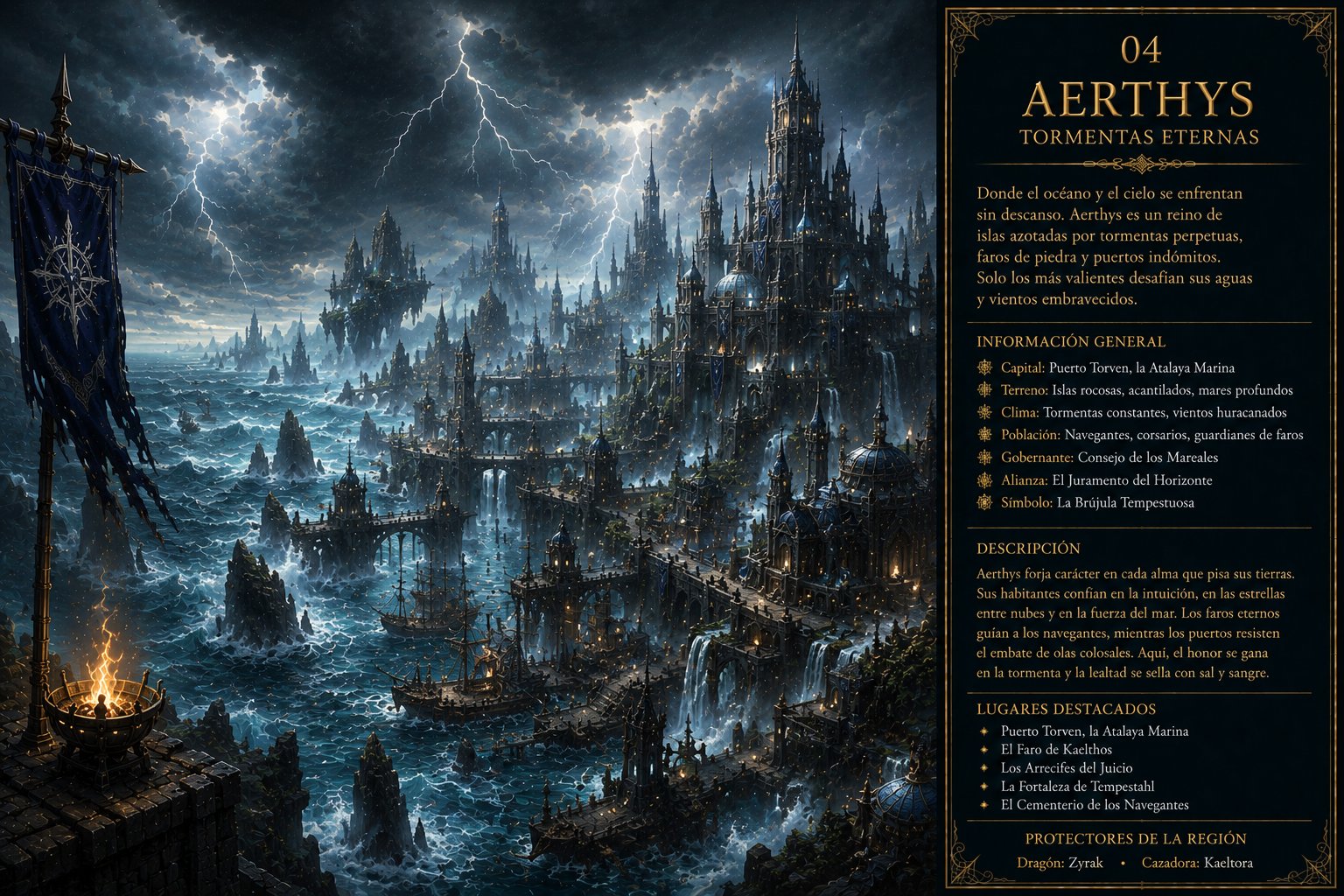
Detailed map coming soon · Region 04 — Aerthys
The first question every outsider asks upon reaching Aerthys is always the same: when does the storm stop? The answer never changes either: it doesn't. The black cliffs of Aerthys have been lashed by lightning and wind without pause since before there was anyone to record it. The continent's oldest texts already speak of the storms of the east as something permanent, inevitable, as much a part of the landscape as the mountains or the sea.
What no one knew for centuries is that the storms are not weather. They are Aerthys. The dragon does not dwell in the region — the dragon is the region. Every bolt that strikes the black cliffs is a beat of its heart. Every storm is an exhalation. Aerthys does not sleep, nor keep watch from any single place. Aerthys is the entire sky above its territory.
Those who chose to live here did not do so for comfort. They did it because the black cliffs hold something found nowhere else on the continent: minerals charged with electrical energy that the world's most advanced smiths have spent centuries trying to obtain, sea routes known only to the sailors of Aerthys, and a way of life that turns the hostility of the land into an advantage.
Kaeltior has sailed those waters for decades. He is the only Named on the continent who does not pursue his dragon — he lives inside it, literally, in the eye of the permanent storm that is Aerthys.
The settlements of Aerthys are built directly into the cliffs — carved from the black rock, sheltered by it, with access to the sea from below and to the sky from above. There are no cities in the region's interior, because the interior is where the storm rages hardest. Everyone lives on the edges.
A city carved into the cliffs of the northern shore. Its streets are tunnels of black rock connecting natural caverns widened over generations. It reaches the sea from below through a system of docks set in caves — the region's only harbor sheltered from the storms. From outside it looks like a wall of rock. Inside, it is a complete city.
The only truly working port in Aerthys. It sits in a cove sheltered by two cliff spurs that break the wind. The ships that arrive here come from far away — only captains who know the exact route can enter without losing their vessel on the reefs at the mouth.
A mining complex in the inland cliffs where the electrically charged minerals are extracted. The work is extremely dangerous — the minerals discharge spontaneously and accidents are frequent. The miners of Aerthys have a working life expectancy of ten years before the accumulated shocks damage their nervous systems beyond repair.
A structure at the highest point of the cliffs. It is not a military watchpost — it is a weather observatory. The watchers of Aerthys have spent centuries recording the storm's patterns, trying to predict its shifts. They hold the most complete records of storm behavior on the continent. No one outside Aerthys has ever read them.
A small settlement of fishers on the only relatively sheltered stretch of coast. Its people are the most sociable in the region — they deal with outsiders regularly, since the ships that reach Low Harbor need provisions. Between them they speak five languages, none of them with a clean accent.
Not a settlement — a graveyard of ships. The most dangerous reef formation on the eastern coast, where the current hurls vessels against the rock with a regularity the region's sailors describe as "punctual." The wrecks of dozens of ships from different eras and regions lie on the bottom. No one plunders them — the currents will not allow it.
The inhabitants of Aerthys are physically distinct — generations of exposure to the ambient electrical discharges have produced a people whose hair almost always stands on end, with extraordinarily quick reflexes and a tolerance for electrical pain that outsiders find unsettling. They are not immune to lightning. They merely take longer to die of it.
Builders and miners. The original inhabitants of the cliffs. They control the Lightning Mines and access to the electric minerals. Their relationship with the black rock is almost religious — they believe every cliff has a memory of its own, and that working the stone without respect brings electrical misfortune.
Sailors and fishers. The most outgoing clan in Aerthys. They know every current, every reef and every storm pattern on the coast. They claim they can smell the weather two days in advance. The other inhabitants of Aerthys do not doubt it.
A hereditary line of weather observers. Not quite a clan — a duty passed from parent to child. The Watchers do not marry outside their own because they fear losing the ability to read the storm that they have honed over generations. They have a reputation for eccentricity, even by the standards of Aerthys.
Aerthys exports three things obtainable nowhere else: electric ore — used by master smiths to forge weapons and tools with unique properties, storm salt — a sea salt with exceptional preserving properties, produced by evaporation under constant electrical conditions, and nautical knowledge — the Kaelen's charts of currents and routes are the most precise on the continent and sell for astronomical prices.
The official currency is the Spark — a coin of smelted electric ore that produces a faint tingling to the touch. Outsiders find it uncomfortable. The people of Aerthys find it reassuring.
The main sea route to the southern and northern regions. Only Kaelen navigators can guide it safely. The price of a Kaelen guide is high but not negotiable — and captains who try to save on the guide generally never reach their destination.
The Aerthoni control the extraction and sale of the electric ore. They do not sell to just anyone — they verify the intended use before closing any deal. They do not want their ore ending up in the wrong hands, though they never specify which hands are the wrong ones.
The nautical charts of the Watchers and the Kaelen are the region's most valuable product. They are sold only in partial copies — never the complete map. To obtain the complete map you must live in Aerthys long enough for the region to accept you. No one has ever defined how long that is.
The most accessible product for outsiders. It is produced in the natural salt flats along the coast, where constant evaporation under electrical conditions creates a salt that preserves food three times longer than ordinary salt. Highly prized in regions without easy access to the sea.
The creatures of Aerthys have evolved in an environment of constant electrical discharge. Most possess some form of resistance or adaptation to electricity. Those that lack it do not survive. The ecosystem of Aerthys is brutal in its selection — what lives here lives because it has earned the right to.
A ray of exceptional wingspan that stores the ambient electrical energy in specialized organs. Its discharge can kill a grown man in the water. Out of the water, it can knock a person down from three meters away. The Kaelen detect them by the hum they produce beneath the surface and change course immediately.
A carrion bird with a four-meter wingspan that nests on the highest cliffs. It does not normally attack the living — but in nesting season it defends its nest with extreme aggression. Its beak can punch through thick leather. Miners working the upper levels always carry a small shield on their backs during the nesting months.
It dwells in the underwater caves beneath the cliffs and can reach six meters in length. Its electrical discharge is enough to disable a small boat. The divers of Low Harbor keep detailed maps of every cave where one lives. Entering a cave without a map is the kind of mistake one makes only once.
A jellyfish up to two meters across that rises to the surface during the fiercest storms. Its tentacles deliver electrical discharges on top of the usual venom. Practically invisible in rough water. The sailors of Aerthys do not put to sea during storms of the highest level — not because of the wind, but because of the jellyfish.
The most common creature in Aerthys. Black plumage with white tips. Completely immune to the ambient electrical discharges — the lightning falling around them simply ignores them. The watchers use them as indicators: when the gulls come down from the cliffs, a great storm is coming.
A black-shelled crab that lives in the crevices of the cliffs. Edible and abundant. The staple of the diet of the fishers of the Cove. Its meat has a faintly metallic taste that outsiders find strange and the people of Aerthys consider normal.
A deep-water fish that produces its own electric light — not bioluminescence but true electricity. Kaelen fishers catch them alive and use them as lanterns in the underwater caves. A well-fed lantern fish can last weeks in captivity and gives enough light to navigate in the dark.
A small lizard that lives in the crevices of the cliffs. It orients itself by the ambient electrical field rather than by sight. When every lizard on a cliff vanishes at the same time, the Aerthoni know a storm of exceptional level is coming and evacuate the upper levels.
A mollusk that generates a local magnetic field to orient itself and communicate with others of its kind. Smiths use them to calibrate magnetic tools. The pearls they produce, steeped in electric ore, have unique decorative properties and sell for very high prices outside the region.
A medium-sized seabird that appears only during storms — it flies straight into the lightning and absorbs it without apparent harm. Kaelen sailors consider them good luck. No one knows where they go when there is no storm. Nor is it known whether there is ever calm enough for them to disappear entirely.
Seen only during storms of the greatest intensity. The watchers describe it as a mass of electricity, vaguely animal in shape, moving within the clouds. It is unclear whether it is a creature, a manifestation of Aerthys, or simply an electrical phenomenon with a coincidental form. The records of the Watcher's Tower hold eighty-three sightings across four hundred years. No one has ever documented two that were identical.
A creature of the abyssal depths that occasionally rises to the surface during the fiercest storms. Translucent, its size varying with the testimony — from two meters to "as big as a ship." The Kaelen keep detailed descriptions in their oral records but do not allow them to be copied in writing. They say writing it down brings bad luck.
The culture of Aerthys revolves around the storm as the axis of all life. This is no metaphor — the storm dictates when to work, when to sail, when to celebrate and when to mourn. To live in Aerthys is to learn to read the sky before doing anything else.
The Great Storm — the day of the year when the storm reaches its greatest intensity. Instead of taking shelter, the Aerthoni climb to the upper platforms of the cliffs and watch. It is neither a joyful celebration nor a mournful one — it is an act of respect. Being present for the Great Storm is mandatory for every adult in the region. Those kept away by illness or age receive a detailed account from eyewitnesses the following day.
The First Bolt — when, after the periods of minimal storm, the first lightning of the high season appears. It is celebrated by lighting torches along the cliffs — not for illumination, but so the lightning has somewhere to strike. It is an invitation. The Aerthoni believe Aerthys chooses where its bolts fall, and that guiding them toward the torches is a form of mutual respect.
The Crossing of the Kaelen — the rite of passage of the young navigators. It consists of putting to sea during a storm of middling level and returning without a guide. The rules are simple: no map, no guide, no outside help. Those who return are Kaelen navigators. Those who do not are remembered in the oral records with the same respect as those who do.
The cooking of Aerthys makes generous use of storm salt — it is in practically every dish. Black Crab Stew is the most common dish, simmered with seaweed and storm salt for hours. Lightning-Seared Fish — technically an exaggeration, but it is cooked on a griddle of electric ore that heats with unusual evenness — is the festival dish. The main drink is Storm Water — rainwater collected during the storms and filtered, which the Aerthoni insist tastes different from ordinary water. Outsiders rarely notice the difference. The Aerthoni rarely believe them.
The Aerthoni do not worship Aerthys as a god — they respect it as a force. The distinction matters to them. A god has a will and can be swayed. A force simply is. The Aerthoni ask nothing of the storm. They only learn to live with it. They believe the dead of Aerthys become electricity — not as metaphor, but literally. When someone dies, the body is laid on the highest platform during the next storm. What remains afterward is what the family buries. What the lightning takes, they say, is already elsewhere.
The dragon does not dwell in the region — the dragon is the region. Every bolt that strikes the black cliffs is a beat of its heart; every storm, an exhalation. Aerthys neither sleeps nor keeps watch from any one place, because Aerthys is the entire sky above its territory, and it has raged without pause since before there was anyone to witness it.
The only Named on the continent who does not pursue his dragon — he lives inside it, in the eye of the permanent storm, and has sailed those waters for decades. He knows the sea routes no chart records and reads the intensity of the sky the way others read weather. To reach Aerthys, you do not climb a mountain; you sail into the heart of the tempest.
13 regions, 13 dragons, 13 legends. Explore the Codex or return to the beginning.