
A magical place can be somewhere a character wants to stay while also preventing them from leaving. To understand the difference between refuge and confinement, ask who controls that choice.
The short answer: look at desire, obligation and the possibility of departure. For readers interested in how fantasy settings shape a story, DRAKHTHAR offers a useful comparison: its Codex lets us examine those pressures beyond the walls of an enchanted bookshop.
What makes an enchanted bookshop an interesting problem?
Amy Coombe’s Hechizada entre libros, published in Spanish by Océano Gran Travesía in 2026, gives us a starting point. The publisher’s description introduces a princess confined to a bookshop until she discovers her deepest desire. She welcomes aspects of this new life, while her parents send princes to break the spell.
The premise invites a question: whose idea of happiness should determine the rescue?
That is an interpretation of the setup, rather than a verdict on the complete novel. We can discuss the tension without guessing its resolution. Enjoying a place and choosing to remain there are different things; the distinction becomes especially interesting when another person insists they know what freedom should look like.
How can a setting change the meaning of staying?
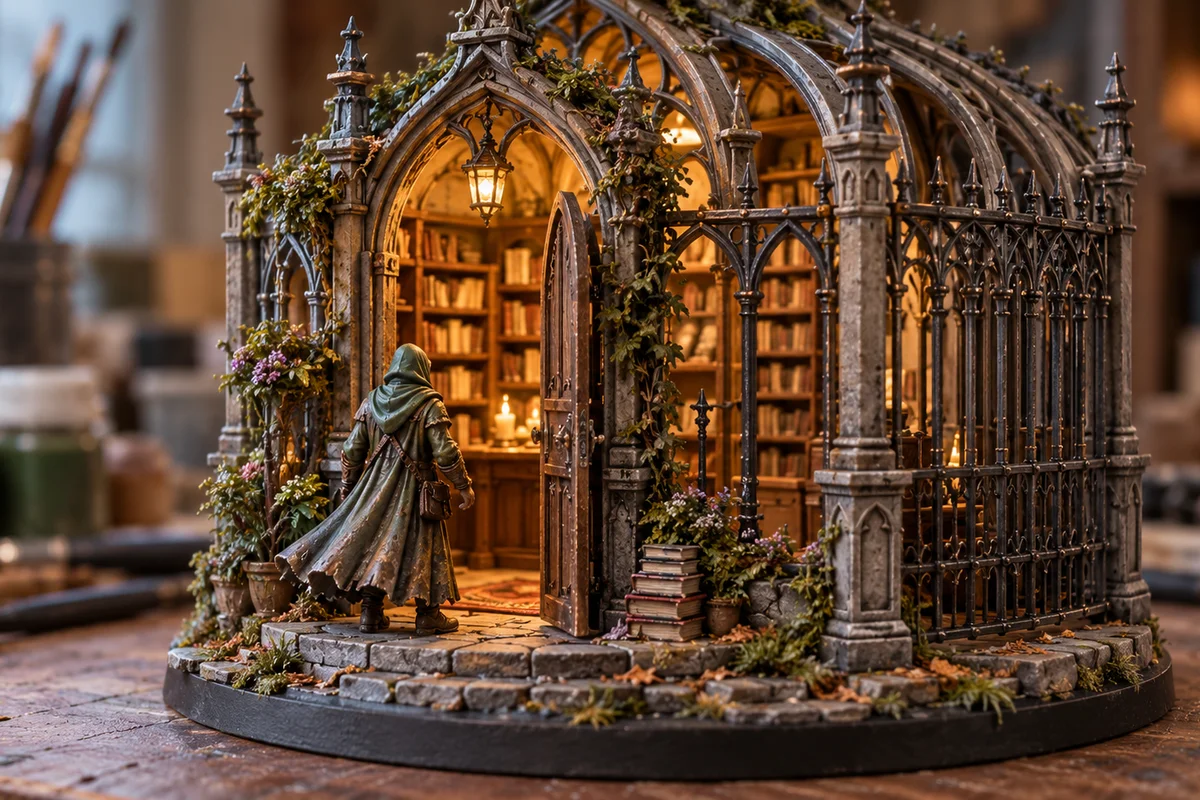
Try describing an imaginary sanctuary twice. First, its inhabitant can leave whenever they wish. Then keep every comforting detail but remove that possibility.
The furniture has not changed. The relationship between person and place has.
Now add a different condition: the inhabitant can leave, but believes departure would harm others. Does staying express love, duty, fear or exhaustion? You would need the story to decide. Architecture alone cannot answer.
These hypothetical variations offer a way to read fantasy without treating every beautiful location as a haven or every forbidding landscape as a prison. Look for the terms of residence: what someone gains, what they surrender and whether those terms can change.
What does DRAKHTHAR add to the comparison?
The DRAKHTHAR Codex provides two concrete starting points. In Lysoria, Ysandra is caught in a seal formed from her memories. In Nocthar, Belmor is considering ceasing to sustain the region’s seal.
Here is our reading comparison. The questions propose interpretations to investigate; they do not supply additional events.
| DRAKHTHAR example | Question about freedom | What to examine while reading | |---|---|---| | Ysandra in Lysoria | What would freedom mean when confinement involves memory? | Whether understanding the situation changes the available choices | | Belmor in Nocthar | What distinguishes continuing willingly from continuing through obligation? | How reasons for carrying on are expressed | | Both examples | Who gets to describe the situation as acceptable? | Whose perspective you have heard and whose remains absent |

This is where the comparison becomes useful for an epic fantasy reader. Instead of measuring a setting only by its geographical size, you can examine the pressure it places on an individual.
Does this make the stories equivalent?
No equivalence follows from a shared question. An enchanted shop, memory and responsibility can produce very different narrative situations. Nor does the comparison establish that DRAKHTHAR offers the same tone as Coombe’s book.
What transfers is a reading habit: pause before accepting that remaining somewhere means wanting to remain there.
You can also question your own expectations. If a character refuses an apparent escape, do you immediately consider that choice mistaken? What information would make you reconsider? Those questions leave room for the story to surprise you.
Where should you begin?
Choose Lysoria or Nocthar in the Codex and write one question about the difference between willingness and obligation. Then use the book section on the DRAKHTHAR home page to approach the narrative itself.
As you read, record a choice and the reason actually given for it. If no reason appears, keep the question open. You will have something more revealing than a favourite location: a specific way to discuss what living there might mean.