
For fine detail and smooth surfaces, resin is usually the stronger choice. For a simpler introduction to printing, FDM deserves consideration. Prusa identifies resin printing with detailed board-game miniatures and describes filament printing as potentially easier for beginners. Prusa’s buying guide.
Our recommendation: choose around the finished figure you want and the work you can accommodate. A collector inspecting a wizard’s face and a player assembling an encounter may reasonably make different decisions.
FDM vs resin miniature comparison: start with the finish
FDM deposits heated filament; resin printing hardens a light-sensitive liquid. UltiMaker’s comparison gives resin SLA the advantage in fine features and surface smoothness. FDM generally shows more visible layers. Technology and finish comparison.
For fantasy figures, we suggest examining faces, armour decoration and curved surfaces before choosing. Request photographs of actual prints at the intended size, preferably unpainted. A digital sculpt shows what was designed, not what a particular printer delivered.
| Your priority | Our suggested starting point |
|---|---|
| Close inspection and intricate painting | Compare resin samples first |
| Learning to print without handling liquid resin | Investigate FDM |
| Everyday gaming pieces | Judge the actual sculpt, material and finish |
| Collecting without operating equipment | Compare finished purchases from both processes |
These are selection criteria, not a ranking of every printer.
FDM printed miniatures: what happens after printing?
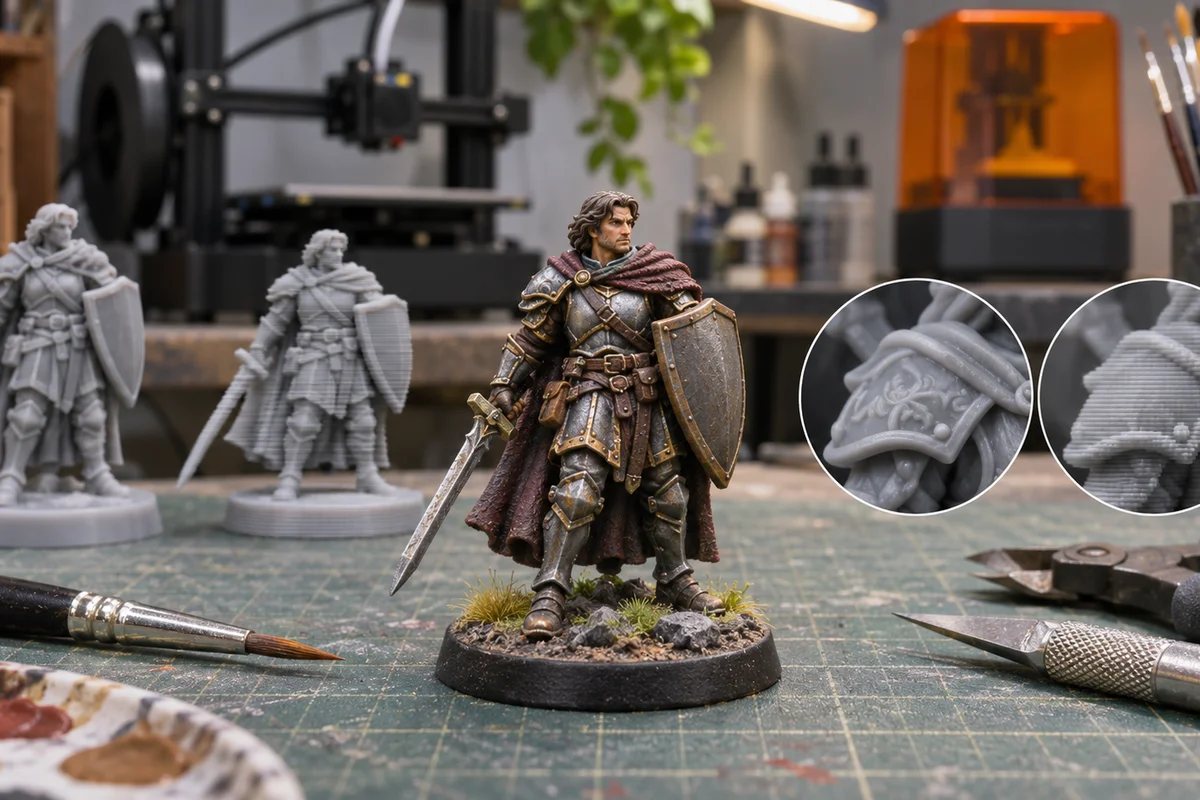
FDM may need support removal and local cleanup. Seeking a smoother finish can add substantial sanding. Resin requires washing and, according to the material, post-curing; support marks may also need attention. Formlabs’ workflow comparison.
Separate hands-on time from elapsed time. Our suggested comparison sheet has distinct entries for printing, cleanup, washing, drying and curing where applicable. Use the selected material’s instructions rather than borrowing another resin’s timings.
A fair comparison also needs the same finishing target. Accepting visible layers on a gaming piece is a different project from preparing a display figure for close photography. Decide that target before judging which process saves work.
Which costs less?
There is no defensible universal price per miniature here. Formlabs includes equipment, materials and labour in its cost discussion and explains why finishing can change the comparison. Cost factors.
Build your own budget from current quotations: printer, material, finishing supplies, protective equipment and waste handling. Record failed attempts rather than counting only successful figures.
If you are buying finished miniatures, compare the delivered price and preparation included. You do not need to own either printing workflow to enjoy its results.
Durability: ask which resin and which filament
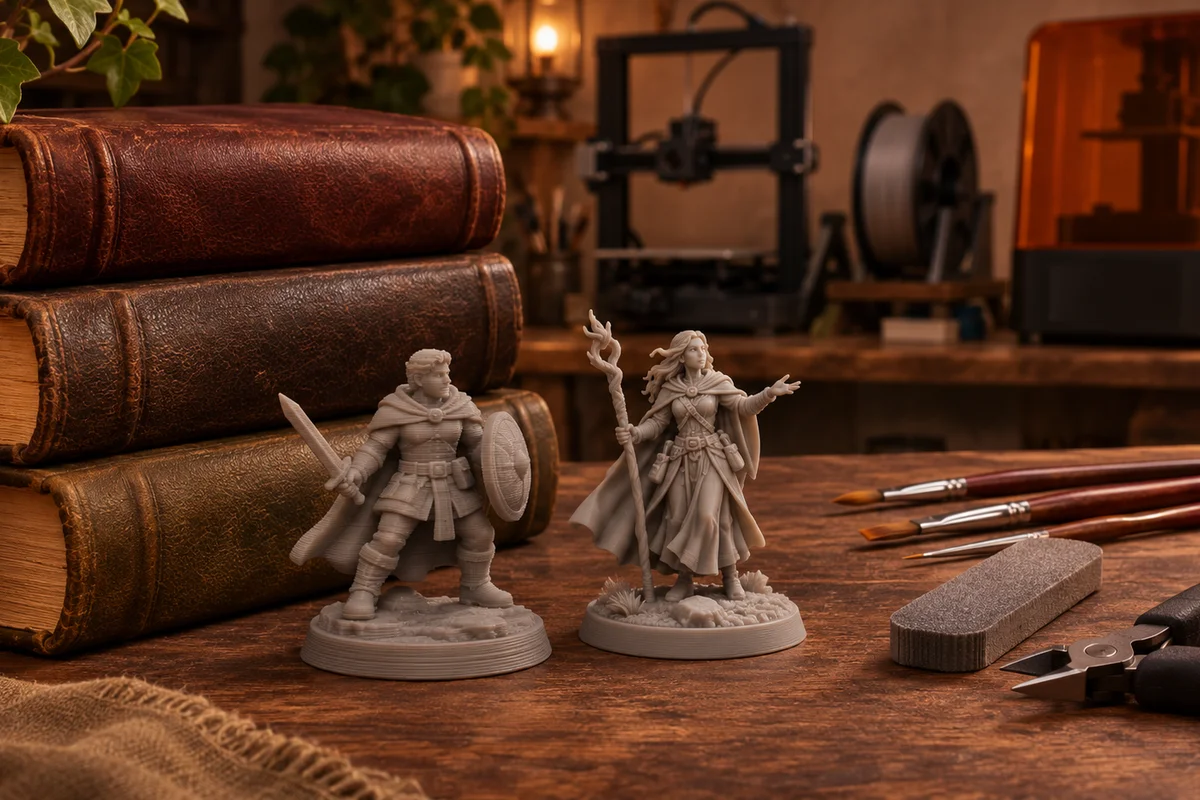
“Resin breaks; filament survives” is too broad. Prusa warns that many resins are brittle under impact, while Formlabs describes tougher resin formulations. FDM strength also varies with direction through its layered structure. Prusa on impact resistance, Formlabs on resin materials, UltiMaker on directional strength.
For gaming, ask for the exact material and relevant handling evidence. We would inspect projecting weapons, ankles and attachment points before accepting a general claim of toughness. A material label alone is not a drop-test result for that miniature.
FDM printing miniatures settings: avoid a universal recipe
Start with a profile matching your printer, filament and installed nozzle. Prusa explains that changing nozzle diameter requires corresponding configuration changes; very small nozzles can bring compatibility and printing-time penalties. Official nozzle guidance.
Our recommendation is to test one representative figure before committing to an army. Inspect the face, support contacts and silhouette. Change one setting at a time and keep notes. No single temperature or speed can be prescribed responsibly without identifying the equipment and material.
FDM or resin for miniatures: let the workspace decide
Liquid resin requires appropriate gloves, eye protection and exposure control, following its safety data sheet. Follow the manufacturer’s washing and curing instructions. Prusa’s safety guidance.
Do not pour liquid resin or resin-contaminated solvent down drains; consult local disposal requirements. Formlabs’ disposal instructions. FDM also needs safety planning: MIT identifies filament-printing emissions and recommends ventilation controls. MIT EHS guidance.
Choose resin when detail justifies that workflow and you can provide it. Choose FDM when its actual finish meets your needs. If neither setup fits your home, buying properly finished figures remains a sensible route to the tabletop.